
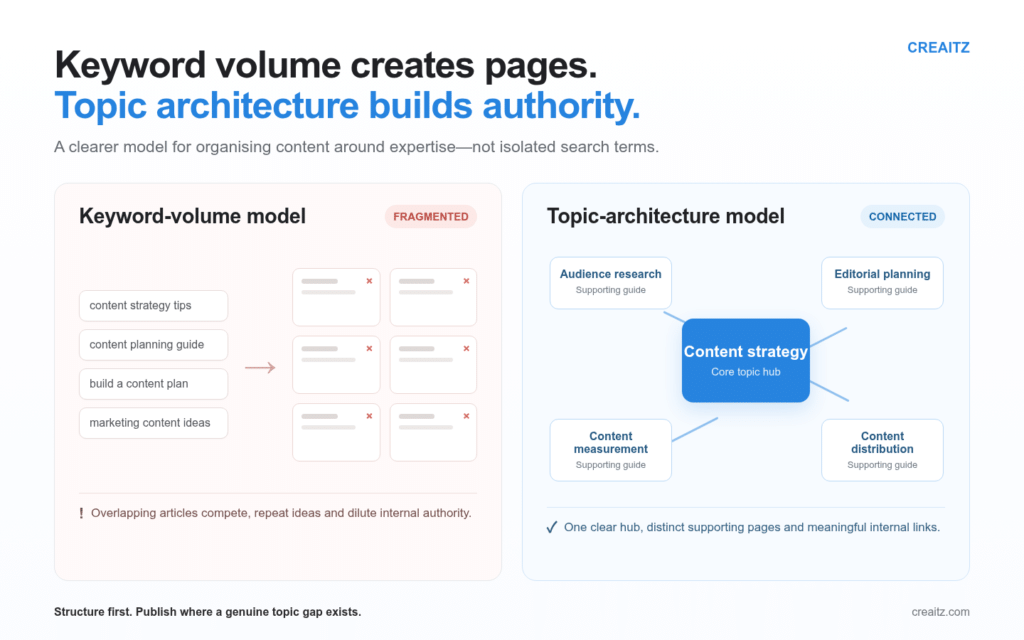
For years, the standard SEO playbook sounded simple: find more keywords, publish more articles, and wait for organic traffic to grow.
That approach worked well enough for many websites—until it didn’t.
Today, marketing teams can publish several articles every month and still see traffic remain flat. Writers are assigned increasingly similar keywords. Editors struggle to distinguish one brief from another. Older pages become disconnected from newer ones, and internal linking turns into an afterthought.
The problem is not necessarily that the content is badly written. It is often that the website does not communicate a clear structure of expertise.
Search engines and AI platforms need more than a collection of individually optimized pages. They need to understand how those pages relate to one another, which subjects the brand genuinely knows, and where each piece of content fits within that expertise.
This is where topic architecture becomes more important than simply increasing keyword volume.
Table of Contents
ToggleWhat is Topic Architecture?
Topic architecture is the way a website organizes, connects, and develops its areas of knowledge.
It includes:
- The main subjects the website covers
- The relationship between broad and specific topics
- The structure of folders and URLs
- Internal links between related pages
- The depth of coverage within each subject
- The consistent entities, terms, authors, products, and ideas associated with the brand
A keyword-led content plan asks: “What search term should we target next?”
A topic-architecture plan asks: “What should our website be recognised for, and what information structure will demonstrate that expertise?”
The distinction matters. A site can rank for several unrelated keywords without building a strong association with any particular subject. It can also publish hundreds of articles while leaving its most commercially valuable topics incomplete.
Topic architecture shifts the focus from isolated pages to a connected body of knowledge.
Keywords are not Dead—but Keyword Volume is not a Strategy
Keywords remain useful. They help marketers understand how people describe problems, what questions they ask, and the type of information they expect to find.
The issue is treating every keyword as a reason to create another page.
For example, imagine a digital-marketing website targeting all of these phrases:
- How to create a content strategy
- Content-strategy tips
- Steps for building a content plan
- How to plan marketing content
- Content-planning guide for beginners
A keyword-volume approach may turn all five phrases into separate assignments. The result could be five articles competing with one another, repeating similar advice and splitting the site’s internal authority.
A better approach might be to create one comprehensive content-strategy guide supported by focused articles about audience research, editorial calendars, distribution, measurement, and content audits.
The keywords still inform the work. They simply no longer dictate that every variation needs its own page.
AI Visibility is Making Topical Depth More Important
This shift is not limited to traditional search rankings. It also affects whether AI platforms recognise and mention a brand.
A 2026 Semrush study examined hundreds of thousands of citation and brand-mention observations across categories tracked in ChatGPT.
It found that brands were both cited and named in 34% of appearances within categories close to their established expertise, compared with only 9% in distant categories.
That does not mean topic architecture is the only factor influencing AI visibility. Content quality, originality, freshness, general brand authority, writing style, and third-party mentions also matter.
However, the findings indicate that topical relevance affects how readily an AI system connects a brand with a subject.
The same study found that being cited and being named are different outcomes. A website may be used as a source across several categories, but direct brand recognition was more strongly associated with categories close to the brand’s demonstrated expertise.
For marketers, the implication is significant. Broad publishing may help individual pages appear, but consistent depth is more likely to build a recognisable brand association.
Why Publishing more Content can stop Producing Results
A growing content library should create more opportunities for discovery. In practice, several structural problems can prevent this from happening.
- Multiple pages compete for the same intent
When content calendars are built from large keyword exports, closely related phrases are often assigned to separate articles.
This can create:
- Repetitive content
- Internal competition
- Confusing page hierarchies
- Weak or inconsistent internal links
- Uncertainty about which page should rank
Before creating a new page, check whether an existing page already answers the same underlying question.
If it does, updating and strengthening that page may be more valuable than publishing another variation.
- Important pages are buried
A well-written commercial page may receive little organic visibility because it sits several clicks away from the homepage and has few relevant internal links.
If a page is important to your business, the surrounding site architecture should make that importance clear.
Relevant guides, supporting articles, category pages, navigation elements, and product pages should connect logically.
A visitor—and a crawler—should be able to understand why the page exists and how it relates to the rest of the website.
- The site covers too many disconnected subjects
A website can publish high-quality articles and still send an unclear signal about its expertise.
Consider a site that publishes isolated articles about graphic design, email marketing, cryptocurrency, productivity, remote work, website hosting, career advice, artificial intelligence, and social-media trends.
Every article may target a real keyword. Collectively, however, the site may not demonstrate meaningful depth in any one category.
This does not mean a brand must restrict itself to one subject forever. It means expansion should be deliberate.
Semrush’s research suggests that brands have a stronger starting point when they expand into categories closely related to subjects where they already have established authority.
- Old content receives no maintenance
Publishing is only one stage of the content lifecycle.
Over time:
- Statistics become outdated
- Screenshots stop matching the product
- Search intent changes
- Links break
- Several short articles begin covering the same subject
- Valuable pages lose internal links as the site grows
A website that publishes weekly but never revisits its existing library may accumulate more content without increasing its usefulness.
Sometimes, the most productive content decision is not to write something new. It is to consolidate three overlapping pages, improve one promising article, and redirect the weaker URLs.
What an Entity-First Content Strategy looks like
In SEO, an entity can be a recognisable person, company, product, place, concept, or other distinct subject.
An entity-first strategy helps search and AI systems understand the relationships among the subjects on your website.
Suppose a digital-talent platform wants to build authority around “freelance digital marketing”. Its architecture might include a central guide supported by connected clusters.
Core guide
- How to build a career as a freelance digital marketer
Skills cluster
- SEO skills for freelancers
- Content-marketing skills
- Email-marketing fundamentals
- Social-media management
- Analytics and reporting
Business cluster
- How to price digital-marketing services
- Writing a client proposal
- Managing multiple clients
- Creating retainers
- Building a portfolio
Client-acquisition cluster
- Finding a profitable niche
- Using LinkedIn to attract clients
- Conducting discovery calls
- Asking for referrals
- Turning case studies into sales assets
The value comes from more than publishing all these pages. Each page should have a clear purpose and connect to the others where it genuinely helps the reader.
Together, they demonstrate that the site understands the subject as a system—not merely as a list of keywords.
How to Audit Your Topic Architecture
Before adding another month of article ideas to your calendar, audit what already exists.
Step 1: Inventory your current pages
Export your important pages into a spreadsheet or content-audit tool.
For each URL, record:
- Primary topic
- Search intent
- Current organic traffic
- Target audience
- Business relevance
- Existing internal links
- Content freshness
- Current ranking range
- Desired action or conversion
The objective is not simply to count your pages. It is to understand what role each page plays.
Step 2: Group pages by real topics
Avoid grouping pages only by exact keywords. Look at the underlying subjects and problems.
For example, “how to price freelance services” and “freelance hourly rate calculator” may use different keywords but belong to the same commercial topic.
Your groups should reflect how readers learn and make decisions.
Step 3: Identify overlaps and gaps
For every topic group, ask:
- Do several pages satisfy the same intent?
- Is there one clear primary page?
- Are supporting pages genuinely distinct?
- Is an essential part of the reader’s journey missing?
- Does the cluster lead naturally to a service, product, newsletter, or other next step?
Mark overlapping pages for consolidation and genuine gaps for future creation.
Step 4: Review pages ranking in positions 4–20
Pages within this range may already have enough relevance and authority to perform but need improvement.
Review:
- Whether the content fully satisfies the search intent
- Whether the title and opening are clear
- Whether examples and evidence are current
- Whether stronger pages link to it
- Whether it competes with another page
- Whether its position in the site hierarchy reflects its importance
Improving a page that already has search visibility can produce results faster than starting from zero with an unrelated article.
Step 5: Map your internal links
Internal links should help readers move through a subject logically.
A useful model includes:
- Supporting articles linking to the main guide
- The main guide linking back to relevant supporting articles
- Closely related supporting pages linking to one another when useful
- Commercial pages connected to the educational content that prepares readers for them
Avoid forcing links into unrelated sentences merely to use particular anchor text. Every link should offer a sensible next step.
Step 6: Consolidate competing content
When two or more pages target the same intent, decide whether to:
- Merge them into one stronger resource
- Reposition one page around a distinct intent
- Redirect an outdated page
- Remove content that no longer serves the audience
Consolidation is not a loss of content. It is the removal of unnecessary competition and confusion.
Step 7: Strengthen entity consistency
Check how your brand, services, authors, products, and main subjects are described across the website.
Keep essential information consistent across:
- About pages
- Author biographies
- Service and product pages
- Structured data
- Social profiles
- Business directories
- Guest contributions and media coverage
Consistency helps people and machines form a clearer understanding of who you are and what you do.
Where Semrush fits into the workflow
A tool should support the strategy, not replace it.
Semrush can help teams evaluate current rankings, compare pages, study competitors, identify topic opportunities, and monitor search visibility. Its AI Visibility Toolkit can also help brands assess where they appear across AI-generated answers.
Semrush’s topical-focus study recommends first identifying the categories in which a brand already earns visibility, then choosing adjacent categories that are genuinely close to that established expertise.
Its suggested workflow uses Visibility Overview to assess current appearances and Topic Opportunities to evaluate where to focus next.
A practical workflow could look like this:
- Use Semrush to identify pages with existing visibility.
- Review pages ranking below the top three results.
- Group those pages into topic clusters.
- Identify overlapping content and missing subtopics.
- Improve the strongest existing pages.
- Add relevant internal links.
- Track whether rankings and visibility change.
- Create new content only where a genuine gap exists.
This is more disciplined than exporting thousands of keywords and turning them directly into a publishing calendar.
Note: If you want to explore these features, you can try Semrush. Creaitz may earn a commission if you subscribe through this link, at no additional cost to you.
What This Means for Different Digital Professionals
Topic architecture is often presented as an SEO concern, but several roles contribute to it.
Content writers
Writers need to know where an article sits within the larger topic. A strong brief should explain the page’s role, the content it supports, and the questions it should answer—not only provide a primary keyword.
Editors and content strategists
Editors can identify repetition, combine competing articles, maintain topic consistency, and ensure every piece contributes something distinct.
Web designers and developers
Navigation, folders, breadcrumbs, redirects, templates, page speed, and structured data can all influence how content relationships are communicated.
Brand strategists
Clear positioning determines which topics a brand should be known for. Without that clarity, content teams tend to chase every popular keyword.
Social-media managers and video creators
Social and video content can reinforce the same core expertise. A strong article can become a video, carousel, email, or discussion thread without creating a disconnected message for every platform.
Founders and marketing leaders
Leadership must decide which topics have commercial value. Otherwise, teams may generate traffic around subjects that never lead to trust, enquiries, subscriptions, or sales.
Architecture Before Acceleration
Publishing more content is not automatically wrong. New pages are necessary when there are meaningful gaps in a website’s coverage.
But volume should follow structure.
Before approving another large batch of articles, ask:
- What do we want this website to be known for?
- Which topics already show signs of authority?
- Which existing pages deserve improvement?
- Where are pages competing with one another?
- Can readers move naturally from education to action?
- Are we expanding into an adjacent subject or chasing an unrelated trend?
- Does every planned article have a distinct purpose?
If these questions do not have clear answers, a larger content calendar may only make the site harder to manage.
The emerging advantage is not simply writing faster. It is building a connected body of useful information that readers, search engines, and AI systems can understand.
Audit the architecture before briefing the next article.
Want to see where your existing content can perform better? Use Semrush to review your rankings, identify topic opportunities, and find pages that may benefit from optimisation before you publish something new.
Disclosure: This article contains affiliate links. If you purchase a product through one of these links, Creaitz may earn a commission at no additional cost to you. We only recommend tools we believe are relevant to our readers.
