
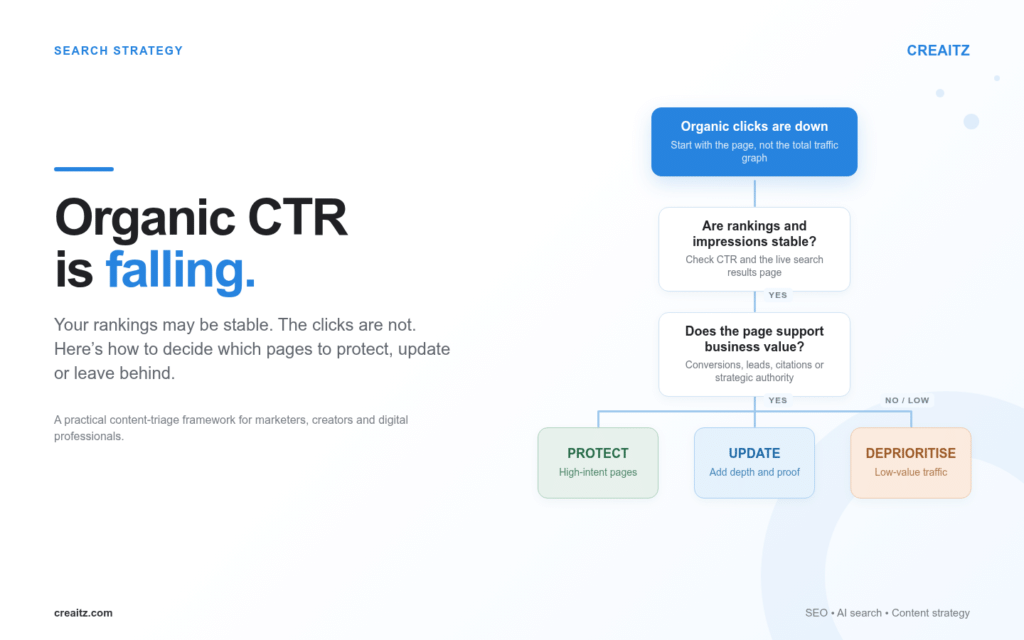
You open your SEO dashboard and see something confusing.
Your most important article still ranks near the top of Google. Its impressions have not collapsed. The content is current, the page loads quickly, and there are no obvious technical problems.
But the clicks are disappearing.
This is becoming a familiar situation for marketers and website owners. So you are not alone.
A page can maintain its search position while attracting less traffic because ranking is no longer the only factor determining whether someone clicks.
The search results page itself has changed.
AI Overviews, featured answers, shopping results, videos, discussion panels, and other search features can answer a question before the user reaches a traditional organic result. The ranking may remain visible, but the need to visit the page has already been reduced.
The new SEO challenge is therefore bigger than ranking higher.
Marketers must decide:
- Which searches still produce meaningful clicks?
- Which content can influence a buyer even without a click?
- Which pages should be updated, repositioned, or deprioritised?
- How can a brand become one of the sources cited inside an AI-generated answer?
Table of Contents
ToggleOrganic Position and Organic Traffic are no longer the same thing
Traditional SEO reporting often assumes a relatively direct relationship:
Better position → higher click-through rate → more organic traffic.
That relationship still exists, but it has become less predictable.
A page ranking first below an AI-generated answer may receive fewer clicks than a page holding the same position on a traditional results page. The ranking did not change; the amount of attention available to that ranking did.
Research collected by Semrush reports that only 8% of users clicked a traditional result when an AI summary appeared, compared with 15% when no summary was present.
The same Semrush resource notes that roughly 60% of searches now end without a click. This does not mean websites receive no value from search, but it does mean traffic can no longer represent the complete value of search visibility.
A person may now:
- Read the answer directly on Google
- Notice a cited brand without visiting it
- Conduct a follow-up search using the brand’s name
- Return later through social media or email
- Ask a similar question in ChatGPT or another AI platform
- Visit a competitor whose brand they already recognise
Your page may influence the decision without receiving the first click.
That is difficult to measure, but it is increasingly important.
Informational Searches are Experiencing the Greatest Pressure
AI-generated answers are particularly suited to questions that can be summarised.
These include searches such as:
- What is content marketing?
- How does email automation work?
- What is a brand strategy?
- How do I calculate engagement rate?
- What skills does a social-media manager need?
The user wants an explanation, definition, formula or short process. If the search engine can assemble an adequate answer within the results page, there may be little motivation to visit another website.
Semrush reports that more than 88% of searches triggering AI Overviews are informational. Commercial, transactional and navigational searches account for much smaller shares.
A Seer Interactive analysis found that the organic click-through rate for informational queries with AI Overviews declined from 1.76% in June 2024 to 0.61% in September 2025, representing a 61% reduction.
This does not mean marketers should stop creating educational content. Informational content still supports:
- Brand awareness
- Topical authority
- AI citations
- Internal linking
- Customer education
- Email acquisition
- Product consideration
It does mean that an informational article needs to do more than provide a basic answer that an AI system can reproduce in a few paragraphs.
The Question is no Longer “Can this rank?”
For years, content teams evaluated ideas primarily through keyword volume and ranking difficulty.
Those metrics still matter, but they leave out an increasingly important question: If this page ranks, will people still need to visit it?
Consider these two searches:
- “What is bounce rate?”
- “Best analytics platform for a Nigerian ecommerce business”
The first can be answered with a definition. The second requires context, comparison, judgement and possibly local knowledge.
Both searches may generate impressions, but they do not carry the same click potential or commercial value.
The first could still be useful as part of a broader analytics learning centre. However, it should not receive the same investment as a page that helps a reader compare options, make a decision or complete a difficult task.
This is why content teams must begin evaluating click potential, not only search volume.
HubSpot’s Traffic Decline Reveals an Important Distinction
HubSpot’s organic decline has become one of the most discussed examples in SEO.
According to a secondary account quoting HubSpot executive Kieran Flanagan, the company lost approximately 140 million visits over 12 months.
However, much of the lost traffic reportedly came from broad informational subjects such as popular quotations and emojis, while more commercially relevant topics—including CRM, automation and software—remained important to the business.
The same account reports that HubSpot achieved record revenue despite the traffic decline.
This does not prove that losing traffic is harmless. Low-intent visitors can still become customers, subscribers, referrers or brand advocates.
The lesson is more precise. Not every lost visit has the same business value.
A website losing 10,000 visits from unrelated definition pages faces a different problem from one losing 1,000 visits from product-comparison pages.
The total traffic number cannot explain that distinction. Marketers need to connect queries and pages to the outcomes they support.
Triage your content by search intent
Instead of reacting to every traffic decline in the same way, divide your content portfolio into four intent groups.
- Transactional content
These pages serve people ready to act.
Examples include:
- Hire a freelance graphic designer
- Purchase an SEO tool
- Register for a digital-marketing course
- Download a paid website template
- Subscribe to an email-marketing platform
Transactional content should receive strong protection because the visitor is close to a decision.
Review:
- Conversion rates
- Product and service clarity
- Trust signals
- Pricing information
- Testimonials
- Page speed
- Calls to action
- Rankings for high-intent queries
A relatively small amount of traffic can generate significant revenue when the intent is strong.
- Commercial investigation content
These visitors are researching options before deciding.
Examples include:
- Semrush versus Ahrefs
- Best portfolio platforms for designers
- Email-marketing tools for small businesses
- Top laptops for video editors
- Freelance marketplaces compared
These pages have good click potential because useful recommendations require context, evidence and judgement.
To make them harder for an AI summary to replace, include:
- Original testing
- Screenshots
- Clear evaluation criteria
- Pricing comparisons
- Local context
- Practical limitations
- Recommendations for different users
- Disclosure of commercial relationships
Avoid producing a generic list that merely repeats product descriptions.
- Complex informational content
These searches are educational, but the answer requires more than a definition.
Examples include:
- How to build an SEO strategy for a marketplace
- How to price a brand-identity project
- How to plan a product launch across multiple channels
- How to structure a content audit
- How to measure influencer-campaign profitability
Complex informational content can still earn clicks when it offers something the search results page cannot conveniently deliver.
That could include:
- A detailed workflow
- Downloadable templates
- Original data
- Expert commentary
- Interactive examples
- Case studies
- Decision frameworks
- Region-specific advice
The goal is not to make an article unnecessarily long. The goal is to make it meaningfully useful.
- Simple informational content
These pages face the greatest risk of becoming zero-click searches.
Examples include:
- Basic definitions
- Simple formulas
- Short checklists
- Common facts
- Straightforward “how-to” questions
Do not automatically delete them. Instead, determine their role.
A basic article may still:
- Support a larger topic cluster
- Answer an existing customer’s question
- Attract links
- Earn an AI citation
- Introduce readers to a commercial subject
- Strengthen internal navigation
However, if a page generates no leads, links, assisted conversions, citations or strategic value, it may not deserve continuous investment merely because a keyword tool reports search volume.
Build Content that gives People a Reason to Click
The best defence against zero-click search is not hiding information from readers. It is creating value that cannot be compressed into a short summary.
Add first-hand experience
Share what happened when you used a process, platform or strategy.
Instead of writing “How to create an online portfolio,” show:
- The platform you chose
- How long setup took
- The mistakes you made
- Screenshots of the process
- The cost
- The result
- Who should use a different platform
Experience creates information that is difficult to assemble from generic sources.
Create original evidence
Run a small survey, analyse a dataset, interview professionals or document an experiment.
The research does not need to involve thousands of respondents. A transparent, focused dataset can be valuable if it answers a specific question.
Explain:
- What you measured
- How you measured it
- Who or what was included
- The limitations
- What the findings mean
Original evidence gives other publications and AI systems a reason to cite your page.
Provide useful assets
An article can become more valuable when it includes something the reader can use.
Examples include:
- Brief templates
- Pricing calculators
- Audit worksheets
- Proposal examples
- Content calendars
- Checklists
- Design files
- Spreadsheet models
However, avoid creating a tool that offers no advantage over what an AI response can generate instantly. The asset should incorporate a thoughtful methodology, save meaningful time or support a repeatable workflow.
Express a defensible point of view
Generic consensus is easy to summarise.
A strong article should explain:
- What most people get wrong
- Where popular advice fails
- Which trade-offs matter
- When the standard recommendation does not apply
- What your experience suggests doing instead
The objective is not to become controversial for attention. It is to contribute a useful judgement that reflects real expertise.
Ranking is Only One Form of Search Visibility
If an AI Overview answers the question, appearing as one of its sources can still provide brand visibility.
Semrush reports that sites featured as AI Overview sources recorded an increase in click-through rate from approximately 0.6% to 1.08% in one study of more than 7,800 queries.
Seer Interactive also found a citation advantage, although it warns that the relationship may not be purely causal. Stronger brands may be more likely both to earn citations and attract clicks.
That caveat matters. There is no guaranteed formula for earning an AI citation.
Still, content is more likely to be useful as a source when it offers:
- Direct answers
- Clear structure
- Verifiable facts
- Original evidence
- Identifiable authors
- Updated information
- Consistent brand expertise
- Descriptive headings
- Supporting references
- Accessible language
The objective is to make the page easy to understand, evaluate, and reference without reducing it to generic information.
The AI-Reporting Gap is Narrowing—but it still exists
Measurement has been one of the greatest challenges in AI search.
Google introduced dedicated generative-AI performance reports in Search Console in 2026. These reports show:
- Impressions within generative AI features
- Pages that appeared
- Countries
- Devices
- Performance over time
Google rolled the reports out globally by August 31, 2026.
This is a meaningful improvement, but the current report does not provide the same query- and click-level detail marketers use for conventional search analysis. Google also states that it is considering additional metrics over time.
Marketers therefore need multiple sources of evidence rather than one perfect dashboard.
A Practical Measurement Workflow
Step 1: Use Google Search Console to identify the decline
Compare recent and previous periods for:
- Clicks
- Impressions
- Average position
- CTR
- Page performance
- Query performance
Look for pages where impressions and positions remain stable while CTR falls.
Those pages may be experiencing changes in the results-page layout or user behaviour rather than a ranking loss.
Step 2: Separate pages by intent
Classify each affected page as:
- Transactional
- Commercial
- Complex informational
- Simple informational
This will help determine the appropriate response.
A transactional page losing clicks requires urgent investigation. A low-value definition page may not justify the same effort.
Step 3: Inspect the actual results page
Search your important queries manually using the location and device most relevant to your audience.
Check for:
- AI Overviews
- Featured snippets
- Video panels
- Discussion results
- Shopping results
- Local packs
- Knowledge panels
- Other interactive features
Do not assume that a stable ranking means the page occupies the same visual position it did six months ago.
Step 4: Use Semrush to monitor rankings and AI visibility
Semrush Position Tracking can help monitor ranking movements and search-result features for selected keywords. Its AI Visibility Toolkit is designed to track how brands appear in AI-generated responses.
Use these tools to investigate:
- Whether an AI Overview appears
- Which domains are cited
- Whether your brand is mentioned
- Whether competing pages have displaced yours
- Which topics create visibility without clicks
- Which commercial queries remain strong
Note: You can try Semrush to monitor rankings, SERP features and AI visibility. Creaitz may earn a commission if you subscribe through this link, at no additional cost to you.
Step 5: Connect pages to business outcomes
Traffic should not be evaluated in isolation.
For each page, review:
- Leads generated
- Newsletter subscriptions
- Product visits
- Trial registrations
- Assisted conversions
- Revenue
- Backlinks
- Brand searches
- AI citations or mentions
This reveals whether the declining traffic represented valuable demand or only inflated the top line of a report.
Your New Search Scorecard
Organic sessions remain useful, but they should sit within a wider scorecard.
Track:
Search performance
- Rankings
- Impressions
- Organic CTR
- SERP features
- AI visibility
Audience response
- Engaged sessions
- Return visits
- Email subscriptions
- Downloads
- Video views
- Social sharing
Business performance
- Qualified leads
- Trials
- Enquiries
- Sales
- Assisted conversions
- Revenue per landing page
Brand visibility
- Branded searches
- Brand mentions
- Third-party references
- AI citations
- Direct traffic
This scorecard helps prevent two mistakes: celebrating traffic that produces no value and abandoning content that influences buyers without generating an immediate conversion.
Do not Abandon Informational Content—Give it a Job
The decline of organic CTR does not mean educational content is dead.
It means every article needs a purpose beyond collecting impressions.
An informational page should help your brand do at least one of the following:
- Become associated with an important subject
- Earn links or AI citations
- Introduce a commercial problem
- Build an email audience
- Educate existing customers
- Support a product or service page
- Demonstrate first-hand expertise
- Move readers towards a decision
If it does none of these, publishing it simply to target another keyword may no longer be a sensible use of time.
Search is moving from a traffic-only channel towards a combination of discovery, influence, citation and conversion.
The brands that adapt will not be those that chase every lost click. They will be the ones that understand which clicks matter, build content worth visiting and remain visible even when the answer appears before the link.
Use Semrush to monitor SERP features, compare competitors, and assess your visibility across both traditional and AI-powered search.
Disclosure: This article contains affiliate links. If you purchase a product through one of these links, Creaitz may earn a commission at no additional cost to you. We recommend tools based on their relevance to our readers.
