
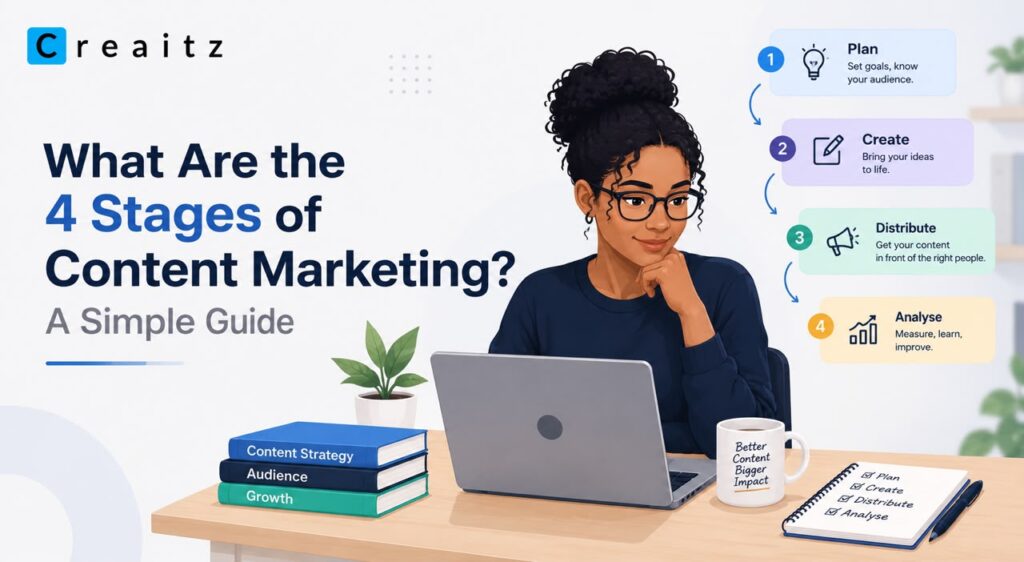
If you’ve ever wondered how a simple blog post or social media caption actually leads to a sale, you’re asking the right question.
Most people don’t buy from the first thing they see. They notice a problem, look for answers, weigh their choices, and only then decide.
This journey has an industry name: the content marketing funnel.
You don’t need to remember that name. You just need to understand the four stages inside it:
Awareness, Consideration, Conversion, and Retention.
This guide breaks down what each of the 4 stages of content marketing actually needs, using one example you can follow from start to finish.
By the end, you’ll know what kind of content to create, and when.
What Is Content Marketing, in Plain English
In simple terms, content marketing means creating helpful content, blog posts, videos, social posts, emails, that attracts people, earns their trust, and guides them toward a useful next step.
Not every piece of content does the same job.
One post introduces a problem.
Another shows you understand it.
A third asks for the sale.
Each stage needs content that matches what the reader is actually ready to do.
The 4 Stages of Content Marketing, at a Glance
- Awareness – get noticed
- Consideration – get trusted
- Conversion – get chosen
- Retention – get kept
People rarely move through these stages in a straight line.
Someone might find you today and buy six months later. That’s normal.
What matters is having something useful ready for wherever they are.
To make this easier to follow, we’ll use one example through the rest of this guide:
Ijeoma, she’s a freelance content writer who helps small business owners fix weak product descriptions.
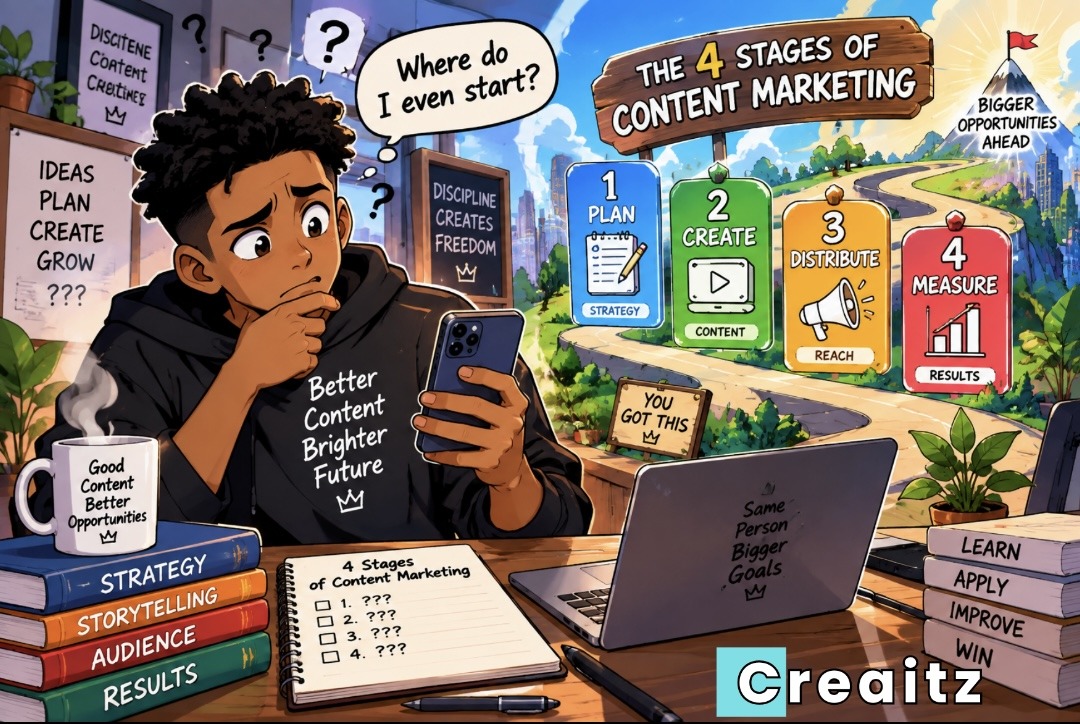
Stage 1: Awareness – Help People Notice the Problem
At the awareness stage, your audience doesn’t know you exist.
Some of them don’t even know they have a problem yet.
Your job here is not to sell. It’s to teach.
Take Ijeoma. Instead of posting “Hire me to write your product descriptions,” she writes something like “How Poor Product Descriptions Are Quietly Killing Your Sales.”
She isn’t pitching anything. She’s pointing out a problem her audience already has, in words they’d actually use themselves.
Content like this works because it’s useful even to someone who never becomes a client.
That’s usually enough to make a stranger pay closer attention.
A simple way to find awareness topics: ask a few people in your audience what’s frustrating them right now, and write down their exact words.
Those words often become your best post ideas.
A free tool like Google Trends can also show you what people are already searching for.
At this stage, keep an eye on things like reach, views, and shares, not sales.
Those numbers just tell you people are noticing you.
If nothing sells yet, that’s normal.
Selling isn’t this stage’s job.
Stage 2: Consideration – Help People Compare Their Options
What matters here isn’t likes.
It’s whether people stick around, reply, or ask questions.
Those are the signs someone is seriously considering you.
Stage 3: Conversion – Help People Decide
At the conversion stage, your audience understands the problem and has already weighed their options.
What they need now is a clear reason to act, with nothing left unclear.
A vague offer creates hesitation. A specific one removes it.
So Ijeoma doesn’t post “Let’s talk about your content needs.” She posts something like: “Get 3 product descriptions rewritten for your store, ₦15,000, delivered in 48 hours, one free revision.”
People can say yes to that right away, because there’s nothing left to figure out:
What they get, what it costs, and how long it takes.
Match your call to action to how ready someone seems.
“Book a call” works well for someone who’s clearly interested.
“Send me a message to get started” works for someone who’s ready but wants a lower-pressure first step.
At this stage, track things like messages, enquiries, and actual sales, not views.
One paying client from a quiet post matters more than likes on a post that never converts.
Stage 4: Retention – Help People After the Sale
Your job doesn’t end when someone buys.
You still need to help them succeed, and stay useful after the sale closes.
Most businesses stop right after payment.
That’s a costly habit, because keeping an existing client is cheaper than finding a new one, and a happy client tells other people about you for free.
After delivering the work, Ijeoma sends a short note with a few tips on using the new product descriptions on Instagram or WhatsApp Status.
It costs her a few minutes, but it makes her client feel looked after, and far more likely to come back or recommend her.
Retention doesn’t need to be complicated.
A quick check-in message, a useful tip, or a small thank-you is often enough.
Watch for repeat orders, referrals, and clients who come back on their own.
Those are the real signs it’s working.
Putting It All Together: One Freelancer, Four Stages
Here’s Ijeoma’s whole approach in one place:
- Awareness: “How Poor Product Descriptions Are Quietly Killing Your Sales”
- Consideration: “5 Things Every Product Description Needs to Convert”
- Conversion: “Get 3 Product Descriptions Rewritten for Your Store, ₦15,000”
- Retention: A short “how to use this” tip sent after delivery
Same person, same niche, four different posts, each doing a different job.
Together, they move someone from a stranger scrolling past, to a paying client, to someone who comes back.
Frequently Asked Questions
Do I need content ready for all four stages before I start?
No. Waiting until everything is ready is one of the main reasons people never publish anything.
Look honestly at where you’re weakest right now.
If nobody’s finding you, focus on awareness.
If people show up but never buy, focus on conversion.
Fix one stage first.
One useful post today is worth more than a perfect four-stage plan sitting in your notes.
Can one piece of content work for more than one stage?
Yes, and it happens more than people expect.
A detailed example of your work can spark awareness when someone finds it online, build consideration because it shows how you think, and lead to conversion if you end it with a clear next step.
You don’t need four separate posts if one well-made piece can carry more than one job.
Just make sure it ends with something the reader can actually do.
How long does it take to move someone from awareness to conversion?
There’s no fixed timeline, and anyone who promises you one isn’t being honest.
Some people decide the same day.
While others could take months.
What usually kills the process isn’t slowness, it’s the silence.
Post once and disappear, and people forget you.
But when you keep showing up with something useful, you’ll stay on their mind until they’re ready to act.
My audience is still small. Does this still work?
Yes, and it can matter even more with a small audience, because every single person counts.
Someone with 200 people who genuinely understand their problem will often get better results than a page with 50,000 followers who don’t.
A bigger audience helps you get noticed faster.
It doesn’t replace having the right content for each stage.
I post regularly, but nothing is converting. What’s actually going on?
In most cases, all your content is stuck at the awareness stage.
Teaching people builds trust, but trust on its own doesn’t create a sale.
At some point, someone has to see a clear offer.
Look back at your last ten posts.
If none of them say plainly what someone can buy from you, that’s the real gap.
It’s not your consistency.
Where to Go From Here
You don’t need to master all four stages overnight.
Pick one audience, one stage, and one small piece of content, then build from there.
If you want feedback and support while you practice this, you’re welcome to join us at the Creaitz community.
It’s a good place to ask questions, share your work, and learn from people who’ve been where you are.
Most importantly, you’ll also gain access to practical resources, expert insights, and a growing network of people building successful careers in digital skills.
