
Someone searches for your business by name.
You might expect your website to explain who you are, what you offer and why someone should trust you.
But what happens when an AI-generated summary answers first?
That summary may draw on your website alongside reviews, directory listings and other third-party pages. Your official description becomes one input—not necessarily the entire answer.
What are Branded Queries?
Branded queries are keywords that contain the name of a business, product, community or professional.
For example:
- Creaitz
- Creaitz courses
- Creaitz community
- Creaitz reviews
Someone making a branded search may already know you. They could be looking for your website, checking your credibility or deciding whether to register, subscribe or buy.
That makes the accuracy of the answer especially important.
How AI Overviews Change the Experience
Google’s AI Overviews summarise information gathered from multiple web sources and include links for further reading. They can also use related searches—known as query fan-out—to assemble an answer.
For a branded query, that means the search experience can extend beyond your homepage.
A prospective customer might encounter descriptions of your services, outside opinions or comparisons before visiting your website.
The opportunity is visibility. The risk is that incomplete or outdated information shapes the first impression.
Ranking prominently and being represented accurately are now separate things to check.
Does this Mean Branded Traffic Will Fall?
Not necessarily.
An AI Overview could satisfy someone’s question without a visit. It could also encourage a qualified visitor to explore your website.
The outcome depends on the query, the answer and what the person wants to do next.
Do not treat the presence of an AI Overview as proof of lost traffic. Check your own:
- Clicks and impressions
- Click-through rate
- Rankings
- Landing-page engagement
- Enquiries, registrations and sales
A traffic decline deserves investigation, but it does not automatically mean the same decline in business value.
Likewise, stable traffic does not prove your brand is being described correctly.
Audit What People See When They Search for You
Start with a few searches that matter to your business: your brand name, your services and questions about your reputation.
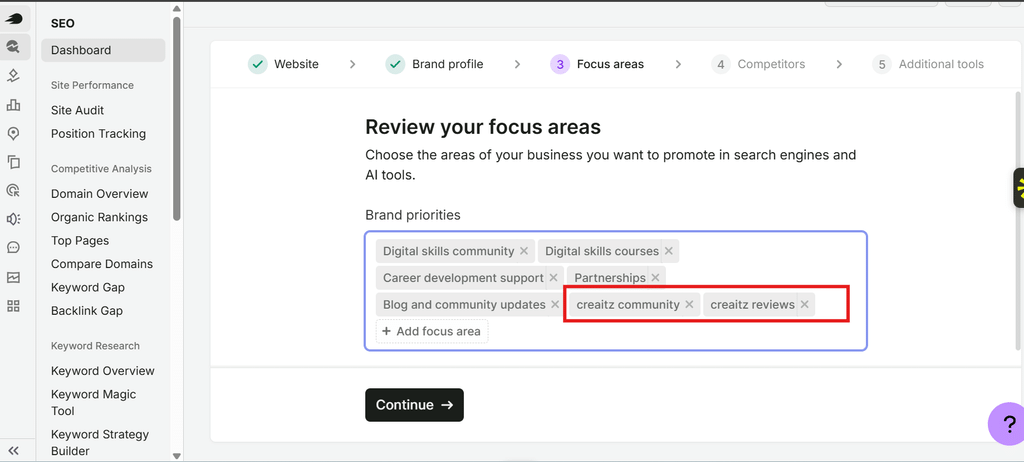
For a digital-skills community like Creaitz, these might include “[brand] courses” or “[brand] reviews.” A freelancer might check their professional name alongside their speciality.
Add those queries to Semrush Position Tracking, using the location and device relevant to your audience. Review the rankings and available AI Overview indicators to identify results worth inspecting.
Then inspect the Google results themselves. Does an AI Overview appear? Does it describe the right organisation? Are its services and contact details accurate? Which sources does it reference?
The indicator tells you a search feature appeared—not whether your brand was represented correctly. Record the query, date and sources so you can revisit the finding.
Follow the Sources Behind the Answer
If an answer misrepresents your brand, rewriting your homepage may not address the source of the problem.
Inspect the pages linked in the Google answer. You can also use Semrush’s AI Visibility reports to investigate relevant brand mentions and cited sources in the available monitored answers.
Other useful actions include:
- Updating outdated directory information
- Correcting inaccurate professional profiles
- Making course or service details clearer
- Keeping author biographies consistent
- Providing an accessible contact page
- Requesting corrections where a factual error exists
Prioritise the sources you actually observe. A review platform important to a software company may have little relevance to a designer or learning community.
Do not manufacture reviews or pressure customers to provide misleading testimonials. The goal is reliable information, not artificial consensus.
Make your official information easier to understand
Before creating more promotional content, review the pages that explain your brand.
Your website should clearly communicate:
- Who you serve
- What you offer
- How someone can participate or buy
- Relevant pricing or eligibility information
- Who is responsible for the organisation
- How to contact you
Clear information helps people evaluate you. It also gives search systems a more coherent source to interpret.
To set up these checks for your own brand, explore Semrush One’s 7-day free trial today.
Report the impact in context
A useful report should distinguish three questions:
- Discovery: Are people finding the brand?
- Representation: Is the brand described accurately?
- Action: Are people taking valuable next steps?
If clicks decline while enquiries remain steady, report both. If rankings remain strong but the summary contains an error, flag that separately.
Record other changes—campaigns, seasonality, site updates and competitor activity—before attributing results to AI Overviews.
This is cross-functional work. SEO may identify a source, while customer support, partnerships or communications help address the underlying information.
Protect the Story—not Just the Ranking
Branded search is more than a route to your homepage. It is a moment when someone decides what to believe about you.
Your ranking still matters. So does the story people encounter before they click.
Disclosure: This article contains affiliate links. If you purchase through them, Creaitz may earn a commission at no additional cost to you.
