
“Your application is only as strong as the story you tell.”
A cover letter is where your story meets opportunity.
It’s your chance to show not just what you’ve done, but why it matters, and why you’re the right fit for the role.
Today, we’ll show you exactly what a cover letter is, its purpose, the types you can use, a template, and how to write one that actually gets noticed.
What Is a Cover Letter
A cover letter is a short, professional document you submit along with your CV to explain why you’re a strong fit for a role.
A cover letter introduces you, it highlights the value you bring, and gives employers context that your CV alone cannot provide.
When people ask “what is a cover letter?” or “what is the meaning of a cover letter?”, this is the simplest and most accurate definition: it’s a personalized pitch that connects your experience to the job you’re applying for.
Whether you’re a writer, designer, developer, marketer, or data analyst, a cover letter is often the only place you can clearly show how your skills match what a company actually needs.
Many recruiters say they can tell in 7 seconds whether they’ll keep reading an application, a focused cover letter helps you make those first seconds count.
It takes your portfolio or CV, which is usually broad, and narrows it down to one clear message: here’s why I’m the right person for this job.
We’ve prepared a full guide on how to write a CV, even if you have no prior work experience. Check it out!
What Is the Purpose of a Cover Letter
Now that we’ve answered the question: what is a cover letter, let’s explore the purposes of a cover letter.
When people ask, “What is the purpose of a cover letter?”The answer is simple: it’s the part of your application that connects your skills and experience directly to the job, succinctly, convincingly, and makes employers see why you make sense.
A CV shows your history. A cover letter shows your relevance.
That’s why hiring managers still read them; they want the context behind your experience.
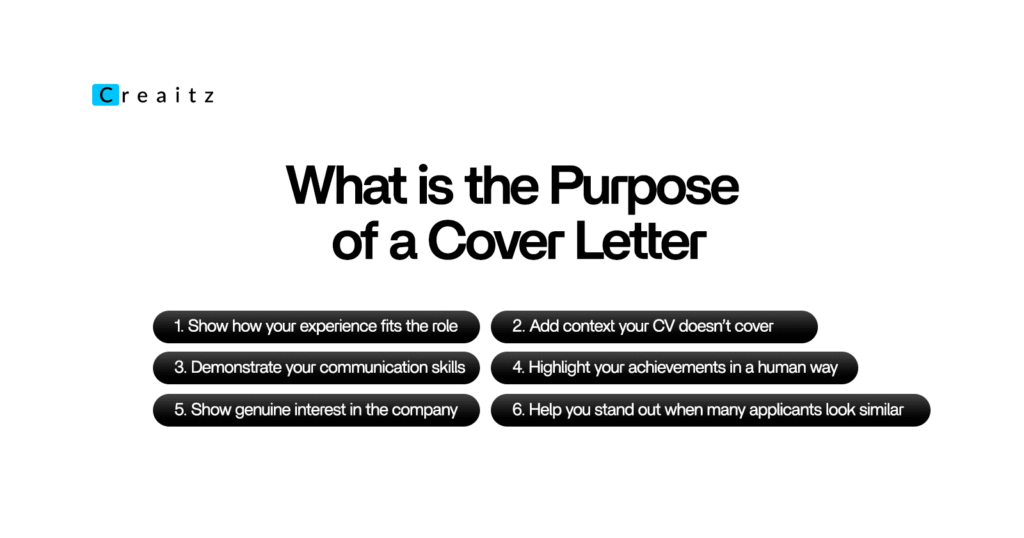
Here’s exactly what a cover letter is meant to do:
1. Show how your experience fits the role
Your cover letter makes it clear how your skills match what the company needs right now.
This is especially important in digital roles where job descriptions list specific tools, metrics, and deliverables.
A clear explanation of how your past work aligns with those expectations helps recruiters see the connection instantly.
2. Add context that your CV doesn’t cover
A CV is structured, but your career story isn’t.
The cover letter fills the gaps, such as why you switched fields, why you’re interested in a particular company, or how a project you handled actually created impact.
Recruiters rely on this context to understand the real meaning of your experience.
3. Demonstrate your communication skills
Across digital careers, from content writing to data analysis, clear communication is a top skill.
A well-written cover letter instantly shows that you can explain ideas cleanly, which is something many hiring managers intentionally look for.
4. Highlight your achievements in a human way
While your CV lists achievements, your cover letter tells the quick story behind them.
If you grew a page, improved conversion, automated a workflow, or fixed a campaign, the cover letter makes those wins relatable and easier for the employer to understand.
5. Show genuine interest in the company
Companies want people who actually care about the role.
A cover letter lets you briefly reference the product, mission, or team, which signals intentionality.
According to a survey by Jobvite, about 45% of recruiters say they reject applicants who show no real interest in the company.
6. Help you stand out when many applicants look similar
In digital fields today, hundreds of people can list “SEO,” “email marketing,” “Python,” “content writing,” or “UI design.”
It is a cover letter that differentiates you by showing how you use those skills, not just that you have them.
What Are the Types of Cover Letters
Before you start writing, it helps to know the different types of cover letters so you can pick the one that matches your situation.
Most people only know the traditional job-application version, but there are actually several formats, each serving a different purpose and helping you position yourself better.
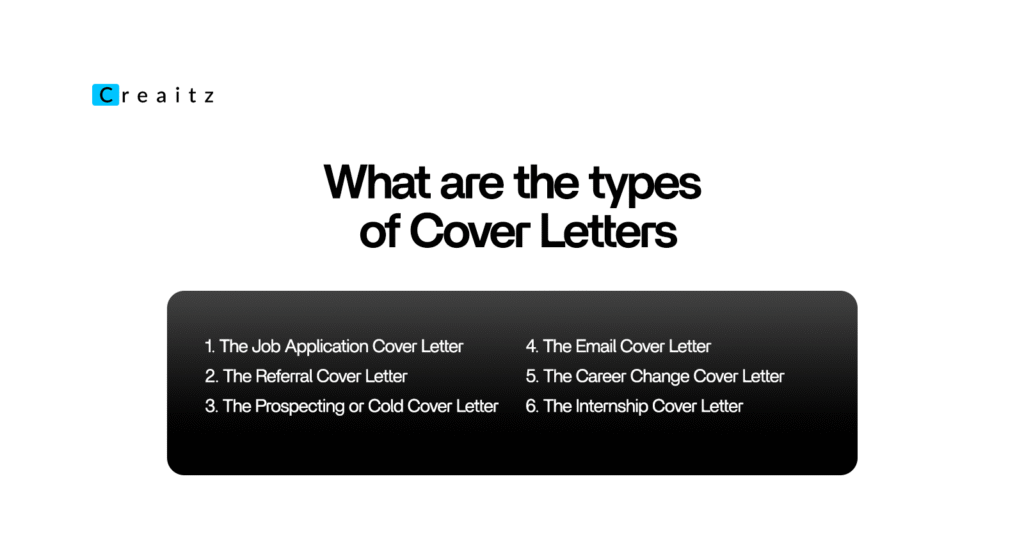
1. The Job Application Cover Letter
This is the most common type, the one people refer to when they ask, “What is a cover letter for a job?” It’s used when a company has an open role, and you’re applying directly.
The goal is simple: show the employer why you fit the job, highlight your most relevant skills, and explain the value you would bring to the team.
2. The Referral Cover Letter
This is used when someone inside the company, maybe a colleague, mentor, or friend, has referred you.
Mentioning a referral early in the letter gives you instant credibility because employers trust recommendations from their own people.
It also helps humanize your application and increases the chance of your CV being read fully.
3. The Prospecting or Cold Cover Letter
A prospecting cover letter is what you send even when the company hasn’t posted a job.
It’s a way of saying, “Here’s how I can help your team if there’s an opportunity now or in the future.”
Digital skills professionals use this often when targeting companies they genuinely want to work with, especially in design, marketing, development, and content roles.
4. The Email Cover Letter
This is a shorter version sent directly in the body of an email.
It works well for startups, agencies, and companies that prefer quick communication.
It still answers the same core questions: who you are, what you can do, and why you’re interested, but in a tighter, more direct format that suits busy hiring managers.
5. The Career Change Cover Letter
This version explains why you’re transitioning into a new field or job type.
Instead of listing irrelevant experience, you connect your past skills to your new career direction.
Digital-skills professionals use this often when moving from general writing to SEO writing, design to product, or social media to digital marketing.
6. The Internship Cover Letter
This is for applicants with little or no experience.
The focus shifts from achievements to enthusiasm, relevant skills, and the desire to learn.
It highlights school projects, certifications, personal work, or small freelance tasks that show potential.
How to Write a Cover Letter
Writing a cover letter becomes simple when you follow a clear structure that explains who you are, why you fit the role, and what value you bring.
Here’s the practical way to do it: this is the same approach recruiters expect and the same format digital professionals use when applying to real jobs.
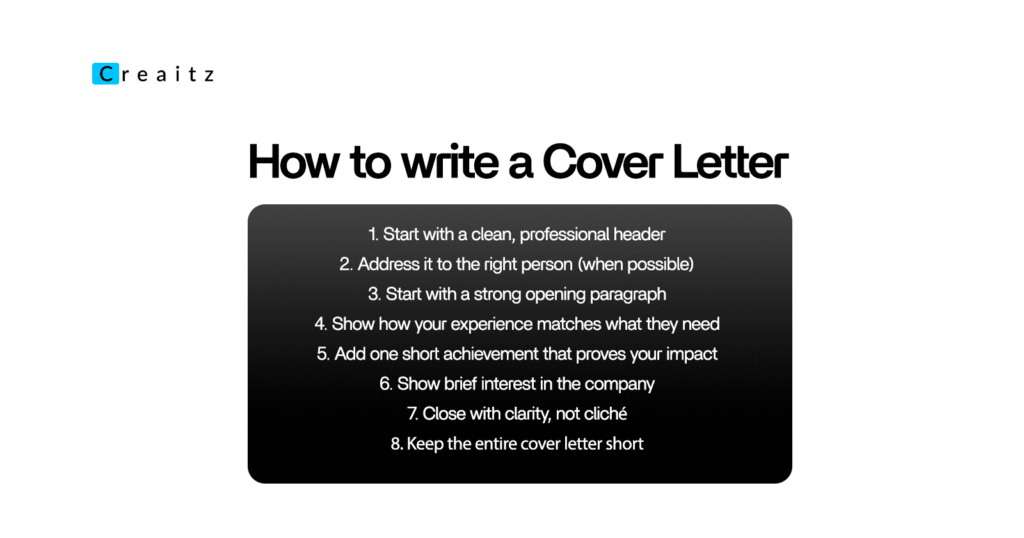
1. Start with a clean, professional header
Include your name, email, phone number, and portfolio link.
For digital-skills roles, your portfolio link is often the first thing employers click, so place it clearly.
Also, keep the header simple, no designs, no colors, just clean formatting.
Do you want to create a professional portfolio but don’t know where or how to start? Check out our full guide on how to create a portfolio.
2. Address it to the right person (when possible)
If the job post mentions the hiring manager’s name, use it. If not, “Hiring Manager” works.
Personalizing it adds a small but meaningful human touch.
3. Start with a strong opening paragraph
Your first paragraph should answer two things immediately: who you are and why you’re applying.
No storytelling, no long greetings.
A direct opener works best because recruiters skim before they decide whether to keep reading.
4. Show how your experience matches what they need
Now this is the most important part.
Look at the job description and select the specific tasks or skills they care about.
Then explain how your past work connects to those points.
For instance, if they need someone who understands SEO, design systems, email funnels, data tools, or content strategy, talk directly about the results you created in those areas.
5. Add one short achievement that proves your impact
For this, you don’t need a long story; you only need one result that feels real.
Maybe you improved conversions, redesigned a page, handled a product flow, or managed a campaign.
Recruiters love clarity.
A clear impact makes your experience feel believable and valuable.
6. Show brief interest in the company
One or two sentences are enough.
You’re not trying to flatter them; you just want to show alignment.
Mention the product, mission, industry, or something specific in their culture or work style.
7. Close with clarity, not cliché
End by reminding them you’re available for a conversation, and you’re open to sharing more about your experience.
No “I remain your humble applicant.” No overly formal lines.
Just a clean, confident closing that sounds like a real person.
8. Keep the entire cover letter short
One page is more than enough.
Recruiters move fast.
A good cover letter is not long; it’s clear. If the thought doesn’t add value, cut it out.
Cover Letter Example
John Doe
johndoe@email.com
0800-000-0000
Portfolio: johndoe.work
Hiring Manager
Tull Holdings
Dear Hiring Manager,
I’m applying for the Digital Content & SEO Writer role at Tull Holdings. I’ve worked on content and SEO projects that improved visibility, engagement, and conversions for different brands, and I believe my experience aligns well with what your team needs.
In my previous role, I handled web content, SEO writing, and content strategy for multiple products. One of my key projects was improving organic traffic on a tech blog by restructuring the content strategy around search intent. Within three months, the blog recorded a measurable lift in rankings and significantly stronger engagement from readers. I’ve also worked on creating landing page content, writing product-led articles, and optimizing existing pages to perform better on search.
What stands out to me about Tull Holdings is your commitment to building digital solutions that actually solve real problems. I’ve followed some of your recent projects, and I appreciate the way your team combines strategy, clarity, and user-focused execution. That approach aligns strongly with how I think about content, SEO, and digital communication.
I’d be glad to share more about my work and the systems I use when approaching SEO content. Thank you for considering my application, and I look forward to the possibility of contributing to your team.
Sincerely,
John Doe
Cover Letter Template
Below is a ready-to-use template you can copy and adapt for any digital role. It’s structured to answer what hiring managers actually look for: clarity, relevance, and value.
Your Name
Your Phone Number
Portfolio/Website Link
Hiring Manager
Company Name
Dear Hiring Manager,
I’m applying for the [Role Title] position at [Company Name]. I have experience in [core skill], [specific task from the job description], and [another relevant skill], and I believe my background aligns well with what your team needs.
In my previous role at [Past Company], I worked on [specific task/project]. One of my key results was [short, clear achievement, e.g., improved conversions, increased traffic, optimized workflow]. I’ve also handled [another relevant responsibility], which strengthened my ability to deliver results similar to what this role requires.
I’m particularly drawn to [Company Name] because of [specific detail about their product, culture, industry, mission, or approach]. The way your team handles [mention something relevant to the company] aligns with how I approach digital work and problem-solving.
I’d be happy to share more about my work, processes, and the results I’ve contributed to past projects. Thank you for considering my application, and I look forward to the possibility of joining your team.
Sincerely,
Your Name
Practical Tips for Writing a Cover Letter
These are practical tips you can apply when writing your cover letter so as to get it read and considered.
1. Tailor it for every application
Even if you’re applying to similar roles, take 10–15 minutes to adjust your cover letter to match each company.
Mention the role, reference a project or product, and link your experience to what they really need. Generic letters rarely stand out.
2. Use numbers to show impact
Instead of saying you “handled a project,” quantify it.
Examples like “increased blog traffic by 35% in 3 months” or “reduced onboarding time by 20%” make your work concrete and easy to visualize.
3. Keep sentences short and clear
Long, complicated sentences make it easy for recruiters to skim and miss the point.
Short sentences keep your cover letter readable and professional.
4. Highlight your relevant skills first
Lead with the skills that matter most for the job.
For digital professionals, that could be SEO, analytics, content strategy, design tools, or coding.
Your strongest, most relevant skills should appear in the first 2–3 lines of your main body.
5. Show you understand the company
A brief sentence about the company’s product, mission, or culture shows you did research and care about how you fit.
Even one specific detail goes a long way.
6. Avoid repeating your CV word-for-word
Your cover letter should add context, not copy your CV.
Use it to explain why your experience matters, how you achieved results, or what you can do for this specific company.
7. Keep it visually clean
Use simple fonts, standard spacing, and one page length.
Formatting should never distract from your content; clarity wins every time.
Now That You Can Write a Cover Letter, Don’t You Need a Job?
Writing a strong cover letter is a major step forward; it shows you can clearly present your skills, your achievements, and why you’re the right fit.
But knowing how to write one is just the start. If you want tips like this, plus updates on real job opportunities in digital skills, join us at the Creaitz community.
It’s where professionals learn, connect, and find the roles that match their skills, all in one place.
In Case You Missed It:
