

“If Google can answer your question before you click, will anyone read your content?”
This is the reality many website owners are facing in 2025.
AI Overviews are changing the game. Search isn’t just about ranking anymore; it’s about being clear, practical, and trusted enough for Google to summarize your work directly in the results.
Whether you’re a content creator, SEO specialist, or digital marketer, understanding what AI Overviews are and how they work isn’t optional; it’s essential.
And in this blog, we’ve prepared everything you need to know about them.
What are Google AI Overviews?

Google AI Overviews are AI-generated summaries that appear at the top of certain search results, designed to give users a quick, direct answer to their query without needing to click multiple links.
AI Overviews pull information from several trusted web sources and present a concise explanation directly inside Google Search.
To make the AI overview meaning clearer: instead of showing ten blue links and letting users figure things out themselves, Google now often provides an instant, synthesized response.
This is what many people refer to when they ask, “What is AI overview?” It’s Google using generative AI to summarize the web for the user.
Google AI Overview results change how people search and consume information. A user searching “how does semantic SEO work” might now see a Google AI Overview explaining the concept in a few paragraphs, with supporting links underneath.
That means users can get clarity faster and decide more selectively which sites to visit.
According to Google, these AI Overviews are designed to help with “more complex questions that previously required multiple searches.”
This includes comparisons, step-by-step processes, and exploratory queries, exactly the kind of searches common in SEO, SaaS, finance, health, and tech.
What makes Google AI Overview especially important is visibility.
Even if your page ranks first organically, the AI overview may appear above it. Your content can still be cited, but only if it’s clear, authoritative, and structured in a way the AI can understand and trust.
How do AI Overviews work?
AI Overviews work by analyzing a user’s search query, identifying intent, and generating a summarized response using information pulled from multiple authoritative web sources.
Instead of ranking pages alone, Google’s systems now interpret content, cross-reference facts, and present a unified answer directly in Search.
At a practical level, when an AI overview search is triggered, Google does three things very quickly:
- Understands intent – Is the user researching, comparing, learning, or looking for steps?
- Selects trusted sources – Content with strong expertise, clarity, and factual consistency.
- Generates a summary – A readable explanation that answers the question upfront.
This is why AI overview Google results are not shown for every query. They usually appear for searches that would normally require multiple clicks, for instance, “how does technical SEO impact crawl budget?” or “difference between first-party and third-party data.”
From a content perspective, Google AI Overviews rely heavily on:
- Clear explanations written in plain language
- Well-defined sections (headings, lists, short paragraphs)
- Content that demonstrates experience and expertise, not just keywords
Google has publicly stated that these systems are built on its long-standing ranking signals, including helpful content and E-E-A-T.
In other words, AI didn’t replace SEO; it raised the bar for it.
Here’s where this becomes very real for digital professionals:
If your article explains a concept better than competitors, more clearly, more directly, and with practical framing, it has a higher chance of being referenced in a Google AI Overview, even if you’re not the biggest brand in the space.
A useful way to think about it is this:
Traditional search rewarded position. AI Overview rewards usefulness.
That shift is why understanding what is ai overview and how it actually functions matters so much now.
It’s not guessing, it’s Google formalizing what “good content” has always meant, then surfacing it faster for users.
How AI Overviews have evolved
AI Overviews have evolved from Google’s earlier attempts to answer questions directly in Search, such as featured snippets and knowledge panels, but with far deeper reasoning and synthesis.
What’s different now is that Google is no longer just extracting answers; it’s generating them by understanding context across multiple sources.
In the early days, search results relied heavily on exact-match keywords and simple snippets.
A featured snippet might pull one paragraph from one page. Today’s AI overview goes further by combining ideas, comparing viewpoints, and explaining concepts in a more complete way.
This evolution accelerated with Google’s advances in language models and its public rollout of generative search experiences.
In 2024, Google rebranded its Search Generative Experience into what we now know as Google AI Overviews, signaling that this wasn’t an experiment anymore, it was becoming core to Search.
This evolution also explains why shallow content struggles now. Pages written purely for rankings, without clear explanations or real-world framing, are harder for AI to trust.
On the other hand, content that teaches, step by step, with context, fits perfectly into how AI Overviews have matured.
AI Overviews vs. AI Mode: What’s the difference?
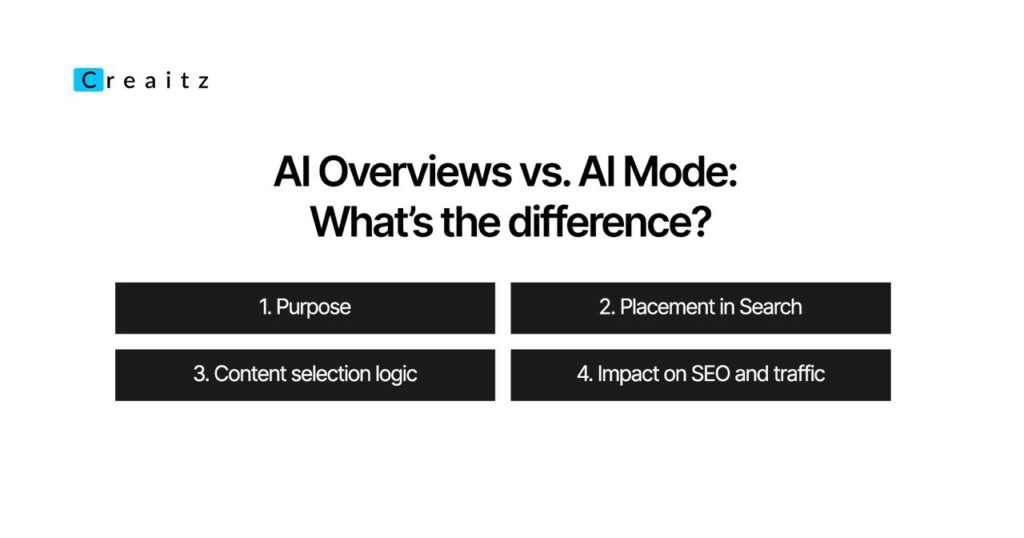
Both AI Overviews and AI Mode serve different purposes in Google Search, even though both use generative AI.
AI Overviews provide quick, summarized answers directly on the search results page, while AI Mode is designed for deeper, conversational exploration of a topic.
Here’s a practical breakdown:
1. Purpose
AI Overviews aim to answer a question immediately.
They appear when Google believes users want fast clarity, definitions, comparisons, explanations, or structured guidance.
AI Mode, on the other hand, is for extended discovery. It allows users to ask follow-up questions, refine their intent, and explore a topic in more depth, similar to a guided research experience.
If someone asks, “What is programmatic SEO?”, an AI overview may explain it in a few paragraphs.
If they switch to AI Mode, they might ask, “When does programmatic SEO fail?” or “Show examples by industry.”
2. Placement in Search
- Google AI Overviews appear directly on the main search results page.
- AI Mode opens a separate, interactive experience.
This distinction matters because visibility in an AI overview search is passive but powerful; it captures attention before any clicks happen.
3. Content selection logic
AI Overviews pull from multiple high-quality pages and summarize them.
They favor:
- Clear definitions
- Structured explanations
- Neutral, factual tone
AI Mode relies more on conversational depth and iterative reasoning, often pulling from broader context rather than just top-ranking pages.
For content creators, this means:
- AI Overviews reward clarity and structure
- AI Mode rewards depth and adaptability
4. Impact on SEO and traffic
This is where things get real.
Being cited in a Google AI Overview can build authority and trust, even if it doesn’t always result in a click.
AI Mode, however, is more likely to send traffic when users want examples, tools, or detailed processes.
In short:
- AI overview = visibility and authority
- AI Mode = engagement and exploration
Understanding the difference isn’t optional anymore.
If you’re creating content without considering how AI overview and AI Mode interact, then you’re optimizing for yesterday’s version of search, not today’s.
How AI Overviews affect SEO
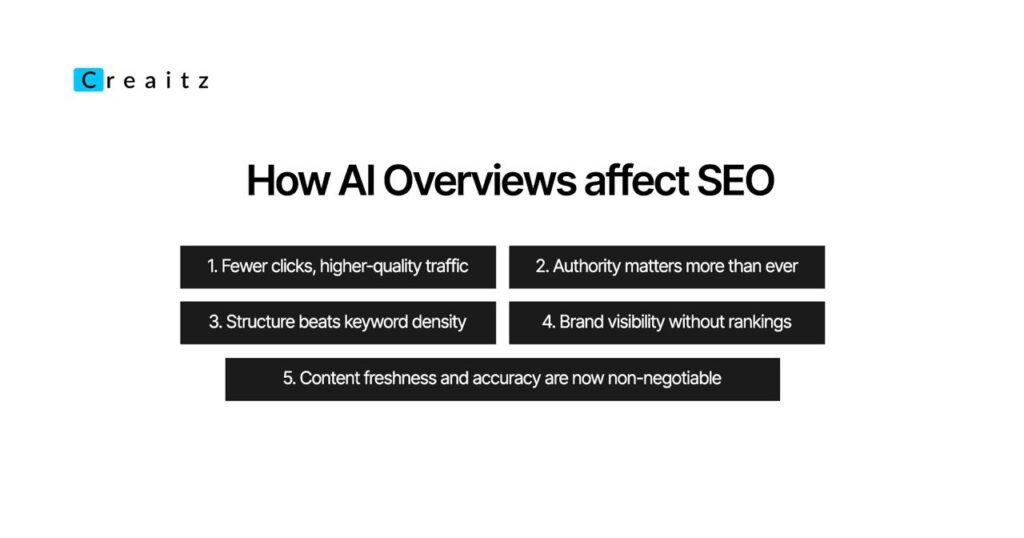
AI Overviews change SEO by shifting visibility from pure rankings to usefulness, clarity, and authority.
While traditional rankings still matter, appearing in a Google AI Overview can now matter just as much, sometimes more than being in position one.
The biggest change is this: users may get their answer before they ever click a link.
That doesn’t mean SEO is dead. It means SEO has become more strategic.
Here’s how AI overview impacts SEO in practical terms:
Want to learn more about SEO? Check out everything you need to get started.
1. Fewer clicks, higher-quality traffic
Yes, some informational queries may see fewer clicks because the AI overview search answers them directly.
However, users who do click are often more qualified; they already understand the basics and want deeper insight.
Google has stated that AI Overviews are designed to “help users decide where to go next.”
In practice, that means clicks now come from intent, not confusion.
2. Authority matters more than ever
AI Overviews don’t pull content randomly. They favor pages that:
- Demonstrate expertise and real-world experience
- Explain concepts clearly and consistently
- Align with established facts across the web
This is where E-E-A-T stops being theory and starts being measurable.
If your content teaches well, Google AI Overview systems are more likely to trust it.
3. Structure beats keyword density
Traditional SEO often rewarded repetition. AI Overviews reward understanding.
Pages with:
- Clear headings
- Direct answers at the top of sections
- Logical flow
are easier for AI to interpret and summarize.
This directly affects whether your content is eligible to appear in a Google AI Overview.
4. Brand visibility without rankings
One of the most overlooked effects of AI overview is brand exposure.
Even when users don’t click, seeing your brand cited repeatedly builds familiarity and trust, especially in B2B and technical niches.
In SEO terms, this means:
- Visibility is no longer binary (click or no click)
- Authority compounds over time through repeated AI citations
5. Content freshness and accuracy are now non-negotiable
AI Overviews strongly favor content that is current, accurate, and consistently updated.
Because a Google AI Overview synthesizes information from multiple sources, outdated or contradictory content is far less likely to be referenced.
From a practical SEO standpoint, this means:
- Old posts with accurate concepts but outdated examples lose visibility
- Pages that are periodically refreshed with new data, tools, or frameworks gain trust
- Clear “last updated” signals help reinforce credibility in AI overview search results
How to optimize for AI Overviews

Optimizing for AI Overviews means creating content that is clear, structured, authoritative, and directly answers user queries.
It’s less about keyword stuffing and more about helpfulness and readability, so that Google’s AI can confidently summarize your content.
Here’s a practical, step-by-step approach for digital professionals:
1. Answer questions upfront
Place the direct answer to a query at the beginning of a section or paragraph.
For example, if targeting “what is AI overview”, start with a clear definition before diving into details. This helps Google identify the main point quickly.
2. Structure content logically
- Use headings and subheadings that mirror potential questions
- Break content into short, scannable paragraphs
- Include lists, tables, and bullet points where appropriate
AI Overviews favor content that’s easy to parse. If it’s messy, it’s harder for AI to summarize accurately.
3. Demonstrate expertise
Include examples, case studies, and references where possible.
Citing authoritative sources improves the trustworthiness of your content, which is critical for appearing in a Google AI Overview.
4. Use natural language
Write in a clear, human-friendly style.
Avoid overly technical jargon unless your audience expects it.
The AI prioritizes content that reads naturally and answers questions in plain language.
5. Keep content accurate and updated
Regularly review content to ensure facts, numbers, and examples remain current.
Fresh, accurate content signals reliability, increasing the chance it will be pulled into AI overview search results.
6. Include related concepts and context
Provide background, examples, and practical use cases for your main topic.
AI Overviews synthesize multiple ideas, so content that explains context thoroughly is more likely to be cited.
7. Optimize for multiple queries
Think of variations of your main question:
- “AI overview meaning”
- “AI overview Google.”
- “What is AI overview?”
Incorporating these naturally ensures your content is eligible for a wider range of AI overview search results without keyword stuffing.
Are You Ready to Make Google Actually Notice Your Work?
AI Overviews are changing the way people find and trust information online.
If your content is clear, practical, and genuinely helpful, it’s more likely to be seen, referenced, and trusted, without relying only on traditional rankings.
The best part? You don’t have to guess what works. If you want tips like this, real insights into how AI is shaping search, or practical strategies to get your content noticed in 2026 and beyond, join the Creaitz community.
You’ll get advice, updates, and actionable tips that can actually help you scale faster.
Want More Like This?
- What is SEO? An Intro to Search Engine Optimization
- How to Use SEMrush Sensor to Boost SEO (Everything You Need to Know)
- The Best Free SEO Tools for 2026
Frequently Asked Questions
AI Overviews are AI-generated summaries displayed at the top of Google search results, powered by the Gemini model. They provide instant, comprehensive answers by synthesizing information from multiple web sources. This speeds up, simplifies and answers complex, multi-step queries without requiring users to click through multiple links.
AI Overviews aim to answer a question immediately. They appear when Google believes users want fast clarity, definitions, comparisons, explanations, or structured guidance.
AI Mode is for extended discovery. It allows users to ask follow-up questions, refine their intent, and explore a topic in more depth, similar to a guided research experience.
