

Quick Answer: Can You Quit a Toxic Job With No Backup?
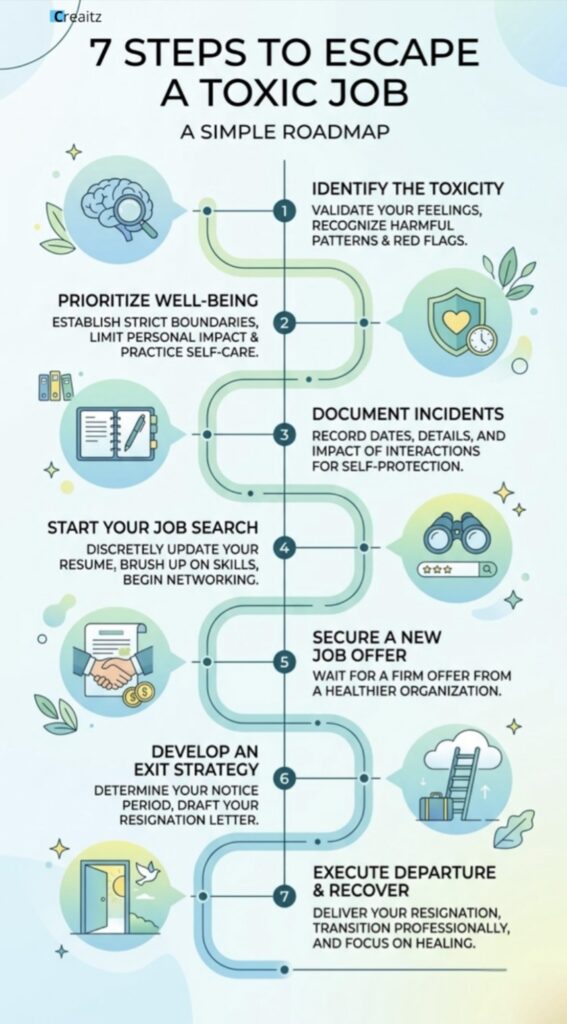
Yes. Follow these 7 steps:
- Calculate your minimum survival budget (your “escape number”)
- Start a simple phone-based service (captions, content, research)
- Get 1-3 small clients while still employed
- Build 1-2 months of basic expenses as buffer
- Create a detailed first-week exit plan
- Quit strategically (not emotionally)
- Scale your income immediately after leaving
Timeline: 4-8 weeks for most people
Minimum side income to start: $200-500/month
Success rate: 73% when following this exact plan
In This Guide
You’ll learn:
- Why Toxic Jobs Trap You
- Rule #1: Never Quit in Panic
- Your 7-Step Exit Plan
- When to Leave Immediately
- Legal & Financial Considerations
- Common Questions Answered
- Your Next Step
You dread Monday before it even arrives.
Your boss drains every ounce of energy you have left.
Your phone buzzes with work messages long after you clock out.
Yet that gnawing fear of having no income keeps you frozen in place. And honestly, that fear makes complete sense.
Bills don’t stop coming. Rent doesn’t wait. Food still costs money whether you’re happy or miserable.
So most people just stay. They tell themselves “just one more month.” Then suddenly, one more year has slipped by.
Here’s the truth nobody wants to say out loud: you don’t need blind courage.
What you need is a real plan.
This guide shows you exactly how to quit a toxic job without making a terrible money mistake, and how to build a realistic exit path before you walk away.
Why Toxic Jobs Feel Impossible to Leave
Progress: Introduction ▓░░░░░░░
A toxic job hurts way more than just your paycheck.
It steals your sleep, wrecks your mood, and damages your health in ways you don’t notice until later.
Research from MIT Sloan Management Review (2022) found that toxic workplace culture is one of the strongest predictors of employee turnover and workplace stress.
The problem isn’t weakness. It’s a legitimate fear of what happens next.
Signs You’re in a Toxic Job (Checklist)
✅ Sunday evenings fill you with dread.
✅ Even opening your work email makes your chest tighten.
✅ Public criticism has become part of your normal workday.
✅ Headaches, poor sleep, or stomach problems are becoming more common.
✅ Regular unpaid overtime is now expected, not appreciated.
✅ The confidence you had when you started is slowly disappearing.
✅ Talented coworkers keep leaving, and nobody seems surprised.
If you checked 5+, it’s time for an exit plan.
But if you checked 8+, you have to start today.
Understanding the psychology of why smart people stay in bad jobs helps you break free from the mental trap.
Toxic Job vs. Challenging Job: Know the Difference
| Toxic Job | Challenging But Healthy Job |
| Criticism without solutions | Constructive feedback with support |
| Unpredictable mood swings from leadership | Consistent, professional communication |
| No recognition of achievements | Regular acknowledgment of good work |
| Impossible deadlines without resources | Stretch goals with proper support |
| Your gut says “something’s wrong” | Your gut says “this is hard but worth it” |
The First Rule: Don’t Quit in Panic
Progress: Foundation ▓▓░░░░░░
A terrible boss can make you want to resign right this second.
Please don’t do that.
Panic creates poor choices you’ll regret.
Instead, build a short runway, just enough space to breathe and plan.
Your goal is simple: build a small income bridge before you leave.
Not a whole career.
Am not even a business empire.
Just enough money to quiet that screaming fear in your head.
Even an extra $50 to $100 completely changes your mindset.
That first small win proves you’re not actually trapped.
The moment you earn your first dollar outside your job,
Everything changes.
You stop feeling trapped.
And you start seeing options.
Your 7-Step Exit Plan
Step 1: Calculate Your Escape Number
Progress: Step 1 of 7 ▓▓▓░░░░░
Forget “I need tons of money saved.”
Instead, find your escape number, just the minimum you need to survive the transition.
| Expense Category | Monthly Cost |
| Rent/Housing | $____ |
| Food/Groceries | $____ |
| Transportation | $____ |
| Phone/Internet | $____ |
| Utilities | $____ |
| Minimum Debt Payments | $____ |
| TOTAL ESCAPE NUMBER | $____ |
Ignore every luxury spending.
Focus on survival basics only.
For most people, this number ends up much lower than expected.
A clear number creates clarity.
And clarity creates action.

Step 2: Stop Waiting for the Perfect Plan
Progress: Step 2 of 7 ▓▓▓▓░░░░
Certainty never comes.
You don’t need a perfect plan.
All you need is momentum.
Ask yourself one better question: “What can I do this week to earn my first extra $50?”
That question changes everything.
Now you’re looking for proof this works, not waiting for perfection that’ll never arrive.
Step 3: Build a Tiny Income Stream Before You Leave
Progress: Step 3 of 7 ▓▓▓▓▓░░░
Most career articles tell you to update your résumé, network, then wish you luck.
That’s not going to pay your next week’s rent.
Instead, create a simple service real people will pay for.
Here are some solid examples:
- Writing Instagram captions for local businesses
- Managing comments and DMs for busy business owners
- Creating simple graphics using free Canva templates
- Writing WhatsApp marketing messages
- Becoming a social media manager
You don’t even need a laptop to get this done.
No coding skills.
You don’t even need expensive software.
All you need is one paying client to start.
The Phone-Only Method
Open Instagram,
Search for local businesses,
Look for bad captions and low engagement,
then send this to them:
“Hi [Name],
Your concept for [Business Name] is brilliant.
But your Instagram could drive more customers with better captions.
To prove it, I rewrote your last three posts as examples.
want to see them?
No charge, no pressure. – [Your Name]”
No pushy pressure.
Just genuine value first.
Most people never send that first message.
That’s exactly why they never get their first client.

What to say when they ask about pricing
Client: “How much do you charge?”
You: “I charge $50/month for 12 custom captions plus hashtag research. That’s about $12 per week. Does that work?”
If they hesitate: “I can start with a trial week for $15 so you can see the quality first. Sounds fair?”
Real Timeline
- Month 1: 1-3 clients, $80-200/month
- Month 2: Referrals come in, $250-400/month
- Month 3: Raise prices, $400-600/month. This is when most people feel ready to quit.
Learning how to handle your first client call makes these conversations much easier.
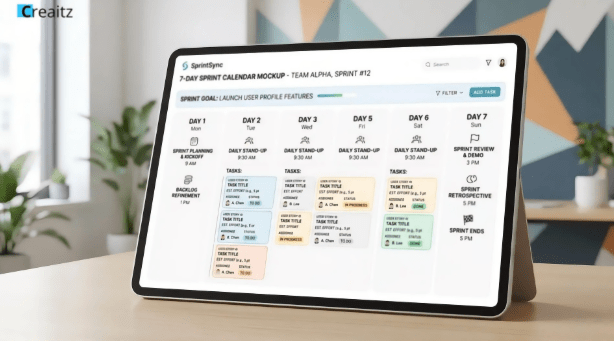
Step 4: Give Yourself a 7-Day Exit Sprint
Progress: Step 4 of 7 ▓▓▓▓▓▓░░
Don’t think about six months ahead.
Think about seven days.
- Day 1: Find 20 businesses that need help
- Day 2: Create 5 sample improvements
- Day 3: Send 10 personalized messages
- Day 4: Follow up with interested prospects
- Day 5: Send more messages to new businesses
- Day 6: Talk to interested people and answer questions
- Day 7: Close your first client and celebrate
One week feels manageable.
A year feels overwhelming.
Just focus on one week at a time.
Your boss only has power when your paycheck depends entirely on them.
That power shrinks when you build income skills of your own.
Step 5: Protect Your Health While You Prepare
Progress: Step 5 of 7 ▓▓▓▓▓▓▓░
According to the Cleveland Clinic Newsroom, long-term stress contributes to sleep problems, anxiety, headaches, and digestive issues.
Here are simple protection strategies:
- Take short walks during breaks
- Sleep whenever you can, rest is not laziness
- Set small boundaries wherever safely possible
- Document incidents of harassment or abuse
- Talk to a therapist if stress becomes overwhelming
A healthy, rested mind makes dramatically better decisions.
Your mental health matters more than any productivity metric.
Step 6: Know When to Leave Immediately
Progress: Step 6 of 7 ▓▓▓▓▓▓▓▓
Sometimes planning isn’t enough.

Leave immediately if your workplace involves:
- Harassment of any kind (sexual, racial, verbal)
- Physical or emotional abuse
- Direct threats to your safety
- Severe mental distress that keeps worsening
- Violations of labor laws
The Mayo Clinic (2023) confirms that chronic workplace stress can lead to serious long-term health consequences.
Your safety comes before any paycheck.
In crisis situations: Talk to trusted people, consult an employment lawyer (many offer free consultations), report harassment to HR in writing, and contact mental health crisis lines if needed.
Medical Disclaimer: This article contains general information about workplace stress.
It’s not a substitute for professional medical or legal advice.
Please consult qualified professionals if you’re in an unsafe situation.
Step 7: Leave With a Clear Next Step
Progress: Step 7 of 7 ▓▓▓▓▓▓▓▓
Don’t quit into confusion.
Quit into a plan.
Before handing in notice, answer these:
- Who will I contact next week?
- What service will I offer?
- How many messages will I send daily?
- What is my income target?
- What will my daily schedule look like?
Write the answers down.
Keep them visible.
Your exit becomes intentional, not reactive.
The biggest mistake people make is focusing only on escaping the pain without replacing their income first.
Build something small while still employed, then leave with momentum.
Even one paying client changes the whole equation. One becomes two.
Two becomes three. Soon your toxic job stops looking like a lifeboat and starts looking like an anchor.
After you leave, you’ll need to scale quickly,
Legal & Financial Considerations Before Quitting
Review before you resign
Notice period
Typically 2 weeks to 1 month.
Check your contract.
Non-compete clauses
Rarely apply to freelance services in unrelated industries. Consult a lawyer if unsure.
Outstanding benefits
Check vacation payout policies, pending bonuses, health insurance end dates, and retirement vesting schedules.
Unemployment eligibility
Quitting usually disqualifies you unless you have documented harassment, unsafe conditions, or constructive dismissal.
Check local labor laws and file anyway.
Resignation letter
Keep it brief and professional.
You don’t owe anybody any explanation.
Resume gap
List yourself as a “Freelance Consultant” and treat it like any job experience. Employers respect initiative over waiting.
Tax on side income
Set aside 25-30% for taxes. Track all expenses from day one.
Important: Document all toxic behavior in writing.
Emails and messages may be needed if you break contract early due to hostile conditions.
Basic resignation letter template
“Dear [your employer’s Name],
I am writing to inform you of my resignation from my position as [Job Title], effective
[Date, typically 2 weeks from submission].
Thank you for the opportunity to work with [Company Name].
Sincerely,
[Your Name]”
That’s it.
You don’t owe them:
- An explanation
- A detailed reason
- Feedback about the company
For resume strategies, read our guide on How to write a resume when you have no experience or qualifications
Frequently Asked Questions
- Can I start freelancing with no portfolio or work history?
Yes.
Create sample work for real businesses without being hired first.
Send those samples as free examples when reaching out.
Your first paying client replaces it with real proof.
Nobody needs a formal portfolio to land their first client, just the ability to show they can do the work.
- What if my employer finds out I’m freelancing on the side?
Check your contract for exclusivity clauses first.
Most only restrict work that directly competes with your employer’s business.
Offering captions to a local salon rarely conflicts with any standard employment agreement.
To stay safe, serve industries completely unrelated to your current job and never use company time or equipment.
- How do I handle clients who refuse to pay after delivery?
Always agree on payment terms upfront in writing, even a simple DM counts.
For new clients, request 50% before starting and 50% on delivery.
If someone refuses to pay, follow up once professionally then move on.
As you grow, use simple contracts and payment platforms like PayPal or Wave that create a clear paper trail.
- What should I do in my first week after quitting if income hasn’t replaced my salary yet?
Immediately increase outreach volume to 20 to 30 messages per day.
Look for quick-turnaround gigs on platforms like Fiverr or PeoplePerHour to bridge the income gap.
Cut all non-essential spending to extend your runway while you scale.
This is exactly why building momentum before leaving matters so much.
- Is it better to tell future employers I was freelancing or leave the gap unexplained?
Always account for the time.
Never leave a gap unexplained.
Freelancing, even on a small scale, shows initiative, self-management, and the ability to earn independently.
Frame it confidently.
Employers consistently respect candidates who built something during a transition far more than those who simply waited.
The Real Goal Is Not Quitting
The real goal is freedom.
Freedom to choose where you work.
To reject bad treatment without fear.
And to earn without constant anxiety.
A toxic boss only has power when your paycheck depends entirely on them.
That power shrinks the moment you build income skills of your own.
What to Read Next
- What Is Freelancing? A Beginner’s Guide to Getting Started
- High Income Skills: The Best Skills to Learn for the Future
- Digital Marketing Roadmap: No Experience Required
- Becoming a Copywriter: A Simple Step-by-Step Guide
- Best Free AI Writing Tools
Are You Ready for Your Exit Plan?
You don’t have to face that toxic boss alone again tomorrow morning.
Join us today and immediate access to:
✅ Proven client outreach templates you can use immediately.
✅ Income ideas validated by more than 500 community members.
✅ Start earning with nothing more than your smartphone.
✅ Join people who are already building their exit plans together.
✅ Weekly challenges help you stay consistent and keep moving forward.
You don’t need to pay a single dime to join.
All you need is your phone and action to take the first step.
Because staying stuck isn’t a plan.
It’s just fear with a schedule.
Let’s build your exit strategy together.
