

Affiliate disclosure: This article contains affiliate links to Semrush. If you sign up through them, Creaitz may earn a commission at no extra cost to you.
You write an article targeting “best portfolio website builder.” It ranks for the keyword, but an AI answer recommending portfolio platforms never references it.
That absence does not automatically mean your SEO has failed. The answer may be drawing on a different combination of questions, sources and selection criteria.
AI search query fan-out helps explain why a single keyword is not always a complete content brief.
You can use this approach to understand your reader’s decision, identify related questions and gather evidence for a more complete content brief. Keep observed AI behaviour clearly distinguished from your planning assumptions.
What is AI Search Query Fan-Out?
Query fan-out happens when an AI search system issues multiple related searches to help construct an answer.
Google confirms that AI Overviews and AI Mode may use this technique to search across subtopics and data sources. It also explains that the two experiences can use different models and techniques, producing different responses and supporting links.
Consider this question:
Which portfolio website builder should a beginner designer choose on a small budget?
A useful answer might need information about:
- Free-plan limitations
- Custom domain costs
- Design flexibility
- Mobile presentation
- Publishing without coding
- Moving the portfolio elsewhere later
These are illustrative research questions, not a captured record of the searches an AI system performed.
That distinction matters. A plausible list is useful for planning, but it is not evidence of a platform’s hidden retrieval process.
Build Your Brief Around the Reader’s Decision
A weak brief might instruct a writer to repeat “best portfolio website builder” and describe ten platforms.
A stronger brief identifies what the reader needs to decide.
For a beginner designer, that could mean:
| Reader’s question | Evidence the article should provide |
| Can I publish without paying? | Current free-plan restrictions |
| Will my work look professional? | Real portfolio examples and mobile screenshots |
| What will I pay later? | Dated pricing and relevant upgrade costs |
| Can I build it without coding? | A documented setup walkthrough |
| Can I move platforms? | Verified export and migration limitations |
These illustrative questions can help you plan your coverage. Confirming the searches an AI system actually performed requires retrieval evidence from that platform.
Use Competitor Gaps as Research Leads
Next, check whether your brief overlooks relevant questions that competing websites address.
In Semrush’s Keyword Gap, compare your domain with a few relevant competitors. Select the appropriate country database, then review Missing or Untapped keywords.
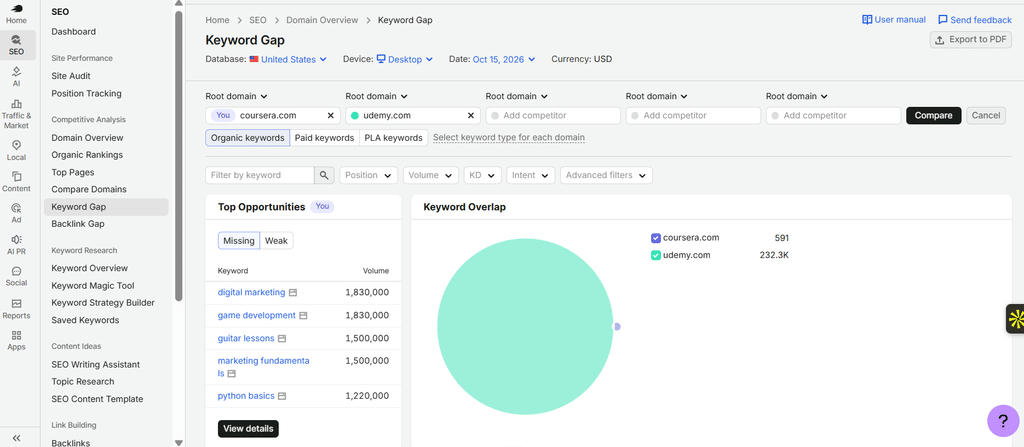
“Missing” identifies terms where all the selected competitors rank but your site does not. “Untapped” identifies terms where at least one competitor ranks and your site does not.
Filter for your subject, inspect the relevant pages, and ask:
- Does this question belong in our article?
- Can we answer it accurately?
- What evidence could we contribute beyond the existing results?
Check whether your page already answers each question before expanding it.
Use keyword gaps as research leads, and keep them separate from any verified evidence of AI fan-out queries.
Improve the Page Where the Answer Belongs
If your comparison article ignores free-plan restrictions, add a clear, sourced comparison.
If setup difficulty matters, document a real publishing attempt. If you have not tested a platform, say that your description is based on its documentation rather than personal experience.
Keep the page focused. A detailed migration tutorial may deserve a separate article linked from the comparison; a short explanation of export limitations may belong directly in the table.
Google says established SEO practices remain relevant to its AI features. There is no special schema or additional technical requirement that guarantees inclusion.
Track Rankings and AI Answers Separately
Record the page’s starting performance before editing it.
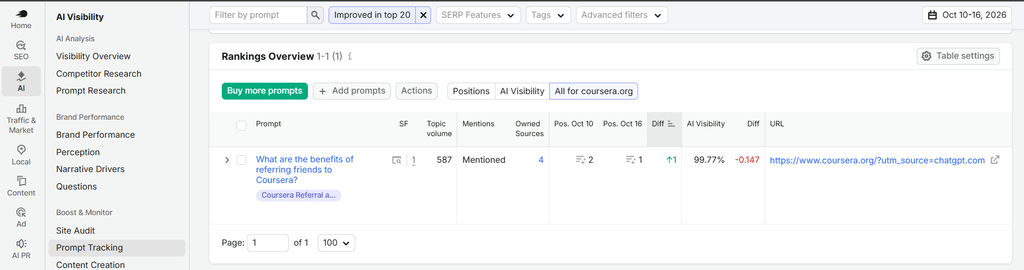
Use Position Tracking for selected keyword rankings and Prompt Tracking for a manageable set of relevant questions on supported AI platforms. Semrush One combines the SEO Toolkit and AI Visibility Toolkit, allowing you to investigate both kinds of visibility within one subscription.
Keep the prompt, platform and location consistent where the tool allows. Inspect the supporting URLs rather than counting every brand mention as a citation.
If you want to try this workflow, explore Semrush One’s 7-day free trial.
Record any AI appearance after your update, together with other changes that could have influenced the result. Establishing causation requires further evidence.
Put AI Search Query Fan-Out Into Practice
The useful lesson from AI search query fan-out is straightforward: one search phrase may represent several connected information needs.
Choose one existing article. Identify the decision it supports. Check the unanswered questions, contribute reliable evidence, and monitor what happens.
You do not need to reverse-engineer every hidden search to make your content more useful.
