
Your client asks a reasonable question:
“Did that article placement help us appear in AI answers?”
You can show the published link. You can report the website’s authority score. But neither answers the question.
This is the measurement challenge facing link builders, digital PR teams and marketers. Earning coverage is one task. Establishing whether that coverage appears in relevant AI answers is another.
For freelancers and digital professionals, learning to separate those outcomes can make reporting more useful—and more credible.
The Gap Between Expectations and Reporting
uSERP surveyed 116 SEO professionals for its State of Backlinks report. Among respondents:
- 81.9% believed backlinks influence whether AI engines cite a brand.
- 79.3% had been asked by a client or senior leader to make AI citations a KPI.
- Only 21.6% tracked citations as a core KPI, while 51.7% tracked them informally.
These are survey responses, not experimental proof that acquiring a backlink causes an AI citation.
Still, they reveal a practical problem: teams are being asked to report an outcome they do not consistently measure.
The answer is not to promise that every placement will generate citations. It is to establish a repeatable way to investigate.
A Strong Link is More Than an Authority Score
In the same survey, 58.6% selected topical relevance as the most important factor when evaluating a backlink. Only 11.2% chose Domain Rating or Domain Authority as the deciding factor.
That does not make authority metrics useless. It means they should not make the decision alone.
Before pursuing a placement, ask:
- Does the publication reach the audience we want?
- Is the proposed page relevant to our subject?
- Does it contain credible, useful material?
- Is the brand mention meaningful within the article?
- Are there signs of indiscriminate paid-link publishing?
- Does the page already appear as a source in relevant AI answers?
Estimated traffic and authority scores provide context, but they are not a guarantee of readership, trust or future citations.
Editorial Note: Paid placements should be appropriately disclosed and links qualified. Do not buy links intended to manipulate rankings.
Start With the Question Your Customer Asks
Suppose you market a portfolio-building tool for designers.
A relevant question might be: “Which portfolio platforms suit beginner designers?”
Before seeking coverage, you can use Semrush’s AI Visibility reports to inspect relevant topics and available AI responses.
And look at the sources those answers reference.
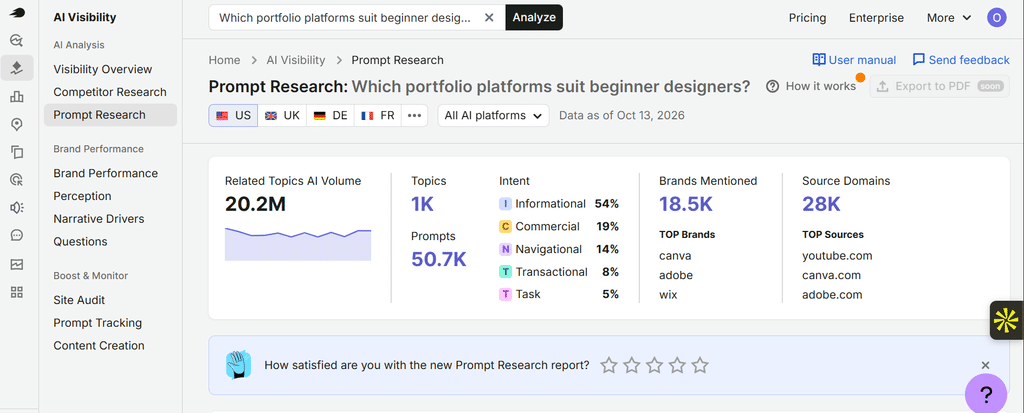
Semrush’s Visibility Overview includes source information and lets you inspect full responses and linked URLs.
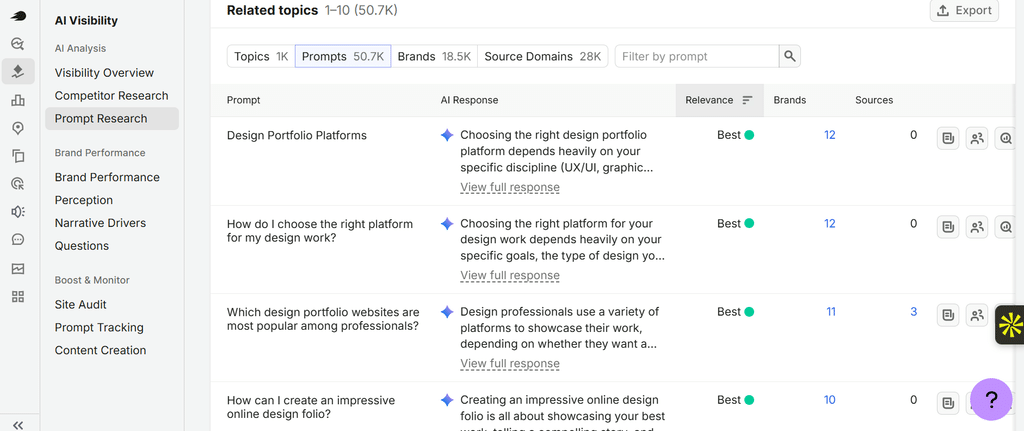
If a relevant comparison page appears, read it. Consider whether your product genuinely fits its audience and whether you have useful evidence to contribute.
A cited publication is not automatically a good placement. Its relevance and editorial standards still matter.
Record the Placement Before Measuring Its Impact
When coverage goes live, save a short record:
- Placement URL and publication date
- What the page says about your brand
- Whether it links to you
- Relevant prompts to monitor
- Existing citation and brand-mention observations
- Other campaigns or website changes happening at the same time
If you’re a freelancer, this can be a simple spreadsheet. The important part is establishing the record before claiming results.
Keep three outcomes separate:
- Placement: Your brand appears on another website.
- Citation: An AI answer references that page.
- Brand mention: The answer names your brand.
An AI system might cite an article that mentions your company without naming you in its response. That is not the same outcome as recommending your product.
Track the Prompt, Then Inspect the Source
Add a consistent set of relevant prompts to Semrush’s Prompt Tracking. The feature supports daily monitoring of brand visibility for selected prompts on supported platforms.
Keep the platform, location and prompt wording consistent when reviewing changes.
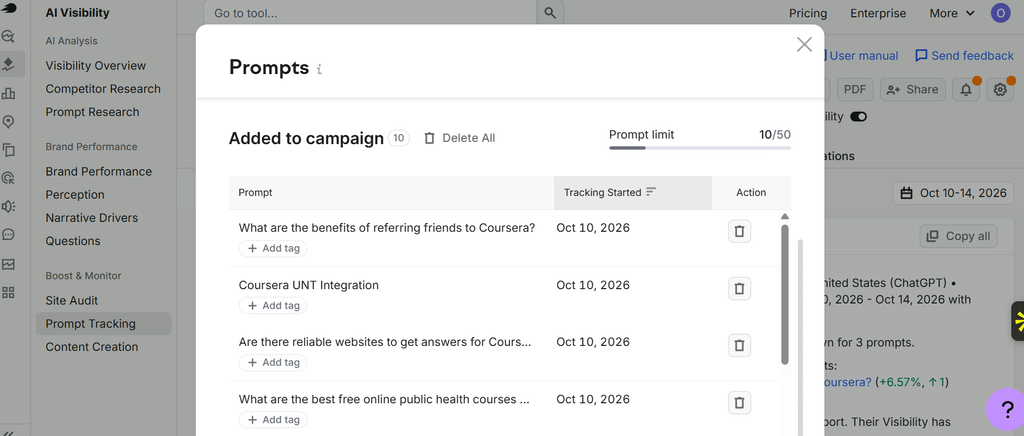
When an answer cites a source, inspect the exact URL. Is it your new placement, a different page on the publication’s website or your own website?
A domain-level citation does not prove that your specific placement was used.
If the available report cannot establish a match to the placement URL, record the result as unconfirmed.
Report Observations—not Guaranteed Attribution
A useful update might say: “After publication, we observed the placement URL cited in a monitored answer. Our brand was also named in that response. This establishes an observed appearance, not proof that the backlink caused it.”
If nothing appears, you can say: “The placement is live, but we have not observed it cited within the prompts and platforms monitored.”
That is more informative than presenting a higher authority score as evidence of AI visibility.
For broader reporting, Semrush’s visibility and Brand Performance reports can add context about your brand presence, share of voice and how the brand is described.
Explore Semrush’s AI Visibility Toolkit to investigate sources, monitor relevant prompts and build a clearer reporting process.
Make the Reporting More Useful Than the Pitch
For marketers, writers and digital PR professionals, the opportunity is not simply to acquire more links.
It is to choose relevant opportunities, document what was published and investigate how that work appears across search and AI answers.
No single metric can replace that process. A high authority score does not guarantee a useful placement. A citation does not guarantee a recommendation. A recommendation does not guarantee a customer.
Show the placement, the monitored question and the observed answer. Be equally clear about what remains unknown.
That is a stronger client report than “we believe the link worked.”
Disclosure: This article contains affiliate links. If you purchase through them, Creaitz may earn a commission at no additional cost to you.
