
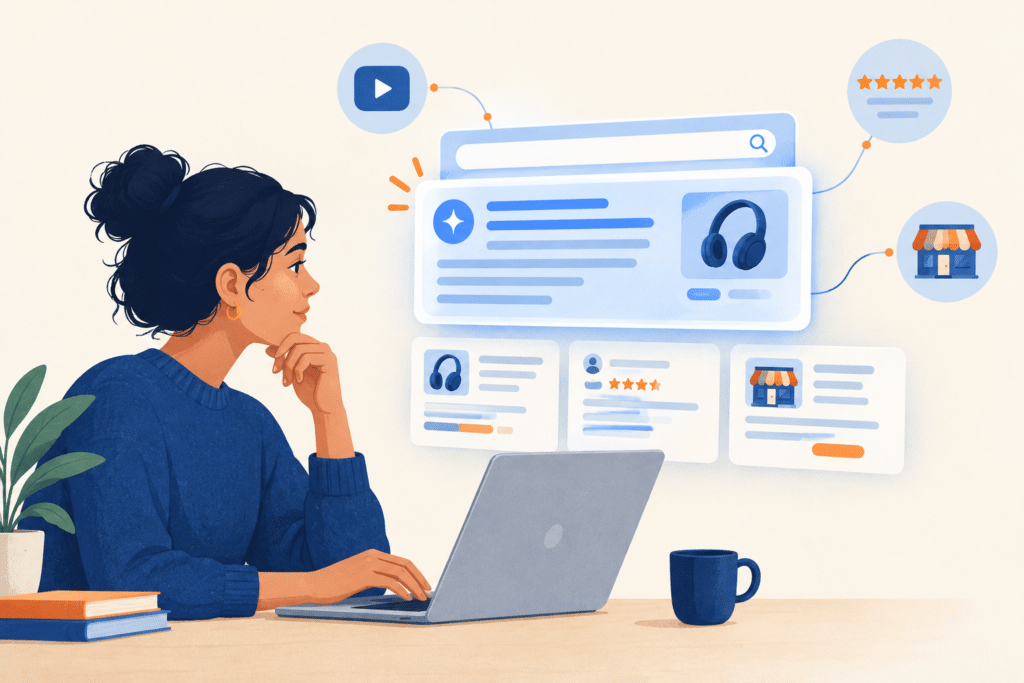
A customer searches for your product and a competitor.
You’ve invested in a detailed comparison page. It ranks well. But before the customer reaches your link, Google presents an AI-generated summary of the options.
That summary may mention your brand. It may cite your page. Or it may rely on a review site, a YouTube video, or a competitor’s content to explain what you offer.
This is the new challenge for businesses investing in commercial search: ranking is still important, but it is no longer the only way your brand can shape a buyer’s first impression.
A Semrush study illustrates how quickly AI Overviews have expanded into searches people make when they are close to a purchase decision.
Table of Contents
ToggleWhat the Semrush study found
Semrush tracked a fixed set of 400 commercial-intent keywords across banking, software, and ecommerce. The research used U.S. desktop data from September 2025 through August 2026.
The keywords included five types of searches:
- Alternatives: “SoFi alternatives”
- Brand comparisons: “HubSpot vs Salesforce”
- Best options: “Best credit union for a car loan”
- Pricing and cost: “Coffee maker under 100”
- Reviews: “Chase checking account review”
Across that sample, AI Overviews appeared for 88% of tracked keywords in August 2026, up from 45.75% in September 2025.
A few findings stand out:
- Review searches saw the biggest increase. AI Overview coverage rose from about 30% to nearly 90%.
- “Best X for Y” searches had the highest coverage: just over 96%.
- All three industries ended between 85% and 91% coverage in the tracked sample.
- Volume-weighted coverage reached 97.08%. In other words, the keywords triggering AI Overviews represented a much larger share of estimated search demand than the keywords without them.
Why 88% and 97% tell different stories
Imagine tracking ten keywords. Nine have modest search volumes, while one is searched far more often.
If an AI Overview appears for only the high-volume keyword, keyword coverage is 10%. But the share of search demand exposed to an AI Overview could be much higher.
That is the difference between the two measures in the Semrush study:
- Keyword-weighted coverage asks: “For what share of tracked keywords did an AI Overview appear?”
- Volume-weighted coverage asks: “How much estimated search demand did those keywords represent?”
In Semrush’s sample, the 12% of keywords without an AI Overview accounted for less than 3% of the total estimated search volume.
For a marketing team, that distinction matters. You might conclude that a few of your commercial keywords are unaffected. But if your most valuable queries are the ones showing AI summaries, those few unaffected terms may not represent much of your audience.
Your comparison page now has a second job
A good comparison page has always needed to answer questions like:
- What does each option do?
- Who is each product best for?
- How do the prices compare?
- What are the limitations?
- Which features matter for a particular use case?
It still needs to do all of that. But now it may also compete to be one of the sources an AI Overview uses when answering those questions directly.
That does not mean a well-structured page is guaranteed to be cited. It also does not mean search rankings have stopped mattering. It means the path between a search and a website visit can include another layer: an answer assembled from multiple sources.
In one example from the Semrush study, an AI Overview for “Mailchimp vs Klaviyo” cited Klaviyo’s own guide alongside Zapier, a YouTube video, and another third-party source.
The important takeaway is not that every search will show the same sources. It is that your website may be only one of several places shaping how your product is described.
How to Audit AI Overviews for Your Brand
You do not need to overhaul your entire content strategy today. Do these instead.
1. Pick five searches that matter
Choose queries connected to genuine buying decisions. For example:
[Your brand] vs [competitor][Your brand] alternatives[Your product category] pricingBest [product category] for [audience][Your brand] review
If you work with clients, start with searches tied to their highest-priority products or services.
2. Record what appears
Search each term and note:
- Whether an AI Overview appears
- Whether your brand is mentioned
- How the overview describes your product
- Which sources are cited
- Whether your website is among them
- Whether the information looks accurate and current
If you are checking manually, an incognito window can provide a useful snapshot. Results may vary by location, device, account, and time, so record those conditions and avoid treating one search as the complete picture.
3. Look for gaps, not just mentions
A brand mention is not automatically a useful mention.
Ask:
- Is the overview describing the right audience for the product?
- Does it include an outdated price or feature?
- Does it leave out an important limitation?
- Does it rely on sources that have not been updated?
- Is a competitor’s page explaining your product in a way you would challenge?
Separate what you actually observed from what you think caused it. If an overview cites an old article, that is worth recording; it does not prove that article alone caused every detail in the answer.
4. Prioritize the fixes you control
If your own pricing page is outdated, update it. If a comparison page avoids the questions buyers actually ask, make the answers clearer.
Useful improvements might include:
- Publishing current pricing or clearly explaining how buyers can get it
- Adding straightforward feature comparisons
- Explaining who the product is—and is not—for
- Including examples, limitations, and relevant details
- Dating and reviewing pages when information changes
For third-party sources, check whether corrections can be requested. Where appropriate, invite customers to share honest reviews in line with the platform’s rules. Do not ask people to leave only positive reviews.
How to report on commercial search now
If your report only includes rankings, you may miss part of the story.
Consider tracking a few additional signals alongside the metrics you already use:
| Signal | What it helps you understand |
|---|---|
| Organic rankings | Whether your page appears in traditional results |
| Search impressions and clicks | How often your page appeared and received clicks |
| AI Overview presence | Whether tracked searches display an overview |
| Brand mentions and citations | Whether and how your brand appears in the answer |
| Source accuracy | Whether cited material describes your offer correctly |
| Conversions | Whether visitors who reach your site take a valuable action |
Be careful when interpreting changes. If clicks decline, an AI Overview may be relevant, but seasonality, competition, ranking changes, search demand, and other factors could also contribute. A before-and-after comparison alone does not prove the overview caused the decline.
If you have access to Semrush Position Tracking or its AI Visibility Toolkit, you can explore how those tools support monitoring. A manual review is also a reasonable starting point—especially when you want to understand a handful of important searches before expanding the exercise.
The question to ask before your next content update
Commercial content is not only competing for a position on a results page. It is also part of a wider conversation about which product to choose and why.
That conversation may include your website, review platforms, videos, community discussions, and competitors.
So before you update your next comparison page or pricing guide, search the query yourself and ask:
What answer does a potential customer see before they reach my website—and which sources are shaping it?
Start with one search. Document what you find. Then decide which correction, update, or content improvement would make the biggest difference.
Read the full Semrush study on AI Overviews and commercial search.
Disclosure: I’m a Semrush ambassador and may earn points and rewards for featuring Semrush.
