
AI can write, code, research and analyse information in seconds. But getting useful results consistently is a different skill.
That is where prompt engineering comes in. If you are asking what is prompt engineering, what the AI prompt engineering meaning is in everyday work, or how to learn AI prompt engineering without a computer science degree or years of experience, you are in the right place.
You need to understand how AI responds to instructions, practise writing better prompts, and apply what you learn to real tasks.
This guide breaks down exactly how to get started, what to learn first, and how to build the skill through practice.
Table of Contents
ToggleWhat is prompt engineering?
So, what is prompt engineering in practice? Prompt engineering is the process of writing and refining instructions that help AI produce a useful result. It is not simply about asking ChatGPT a question. It is about giving the AI enough context, direction and constraints to understand what you actually want.
For example, asking:
“Write a blog post about cybersecurity.”
gives the AI very little to work with.
A more useful prompt might be:
“Write a 1,000-word beginner-friendly blog post explaining common cybersecurity threats to small business owners. Use simple language, include practical examples, and avoid unnecessary technical terms.”
The difference is obvious. The second prompt tells the AI what to do, who it is writing for, how detailed it should be and what the finished result should look like.
That is the basic idea behind prompt engineering: turning a vague request into clear instructions that guide AI towards a more useful output. In simple terms, the AI prompt engineering meaning comes down to communication: explaining a task clearly enough that an AI tool can respond in a genuinely useful way.
Why prompt engineering matters
Understanding the AI prompt engineering meaning is one thing. Seeing why it matters is another. Knowing how to use AI effectively can make everyday digital work faster, clearer and more efficient. It is useful beyond simply getting better answers from a chatbot.
Here are some practical reasons to learn it:
1. It helps you get better results from AI
A vague prompt can produce a vague answer. Clear instructions give AI more context about what you need, which can make its output more relevant and useful.
2. It can save time on repetitive tasks
You can use well-designed prompts to help with tasks such as summarising documents, organising research, creating content outlines, analysing information and generating first drafts.
3. It works across different digital skills
Prompt engineering is not limited to writers or developers. Marketers, designers, researchers, analysts, project managers and other digital professionals can use the same principles in their work.
4. It helps you work with AI more deliberately
Instead of accepting the first answer an AI tool gives you, you learn to provide context, set constraints, give examples and refine the result until it better matches your goal.
5. It makes your existing skills more useful
AI does not remove the need for subject knowledge. Someone who understands marketing, SEO, coding or data analysis can often get more practical value from AI because they know what a good result should look like and can tell when something is wrong.
6. It gives you a skill you can practise immediately
You do not need to wait until you finish a long course before practising. Take a real task you already perform, give it to an AI tool, examine the result and improve your instructions. That feedback loop is where much of the learning happens.
Explore More: Top 7 AI Website Builders in 2026
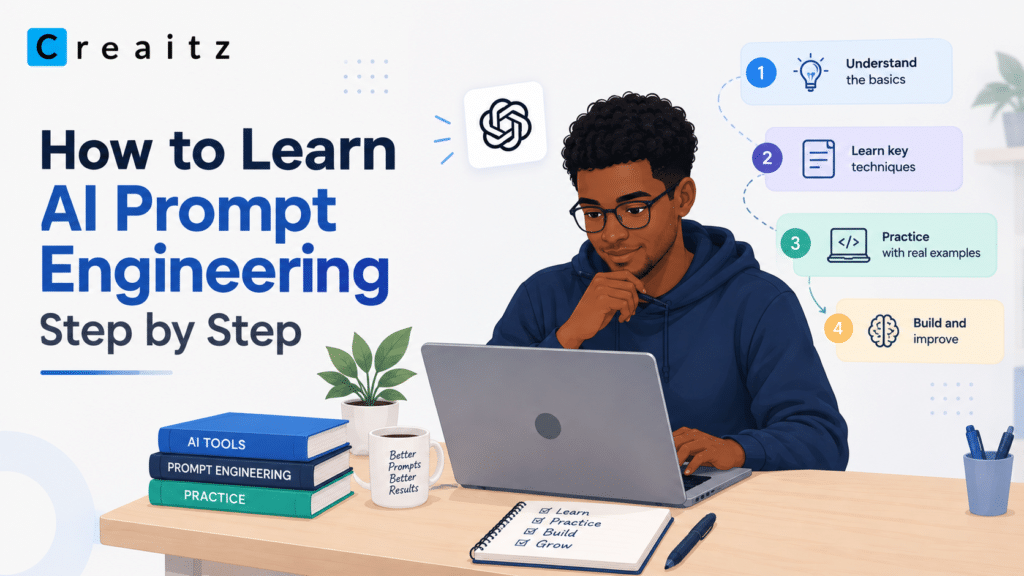
How to learn AI prompt engineering step by step
The best way to learn AI prompt engineering is through practice. You do not need to master every AI tool or memorise complicated prompting formulas before you begin. Start with tasks you already understand, experiment with your instructions and learn from the results.
Here are seven practical steps to get started.
1. Start by understanding how AI responds to prompts
Before you focus on writing sophisticated prompts, learn the basic relationship between an instruction and an AI response.
AI tools do not understand your request in exactly the same way a person would. The information you provide, the way you phrase your instructions and the context you give can all affect the response.
Start by taking a simple task and asking an AI tool to complete it. Then change one part of your prompt and compare the results.
For example, try:
“Give me ideas for a LinkedIn post about remote work.”
Then make the instruction more specific:
“Give me five LinkedIn post ideas about the challenges of remote work for early-career professionals. Keep each idea practical and suitable for a professional audience.”
Compare the two responses. Look at what changed and why.
This simple exercise teaches one of the most important principles of how to learn AI prompt engineering: better prompting starts with understanding what information the AI needs to complete the task properly.
2. Learn the basic parts of an effective prompt
Once you understand how small changes can affect an AI response, start learning what makes an instruction clearer.
A useful prompt will often contain some combination of:
- Task: Tell the AI exactly what you want it to do.
- Context: Give it information it needs to understand the task.
- Audience: Explain who the result is intended for.
- Format: Specify whether you want a table, list, email, article, summary or another format.
- Tone: Describe how the output should sound when this matters.
- Constraints: State what the AI should include, avoid or stay within.
- Examples: Show it an example when the desired result is difficult to describe.
You do not need every element in every prompt. The goal is to provide the information that matters for the particular task.
For example, a content professional could turn “write about SEO” into:
“Create a 10-point outline for a beginner-friendly article about SEO for small business owners. Use simple language, focus on practical actions they can take themselves, and avoid technical jargon.”
The second prompt gives the AI a much clearer job.
3. Practise with tasks you already do
One of the easiest ways to learn prompt engineering is to practise on work you already understand.
If you are a content writer, experiment with research summaries, outlines, headline ideas or content briefs. As a marketer, you can also try campaign ideas, audience research or social media variations. If you are a developer, experiment with debugging, documentation or explaining code.
This approach is useful because you already know what a good result should look like.
For example, instead of randomly asking AI to “write something about marketing”, take a real task from your workflow and create a prompt for it. Review the response against your own professional standards.
That comparison is important. Prompt engineering is a skill, but using AI effectively also requires knowing when its answer is incomplete, inaccurate or simply not very good.
4. Learn to improve a prompt instead of starting again
Your first prompt does not have to be perfect.
In fact, one of the most useful parts of how to learn AI prompt engineering is getting comfortable with refinement. If an AI response is too long, unclear, generic or unsuitable for your audience, identify the problem and change the instruction.
Suppose you ask:
“Explain blockchain to beginners.”
The answer may still be too technical.
You could follow up with:
“Rewrite this for someone who has never used cryptocurrency. Use one everyday example, explain unfamiliar terms and keep it under 300 words.”
You have not simply asked the AI the same question twice. You have diagnosed a problem with the first output and given the tool more precise instructions.
Keep a record of these changes. Over time, you will start recognising which types of instructions consistently improve your results.
5. Experiment with different prompting techniques
Once you are comfortable with basic prompts, start testing different ways of giving AI instructions.
For example, you can ask the AI to:
- Break a complex task into steps before completing it.
- Use an example to follow a particular format.
- Adopt a specific role or perspective when that context is genuinely useful.
- Compare several options using clearly defined criteria.
- Ask you for missing information before completing a task.
- Critique and improve an existing piece of work.
- Return information in a specific structure, such as a table or checklist.
Do not treat these techniques as magic formulas. A prompt that works brilliantly for one task may be unnecessary for another.
The aim is to understand why a technique works and when to use it.
6. Build prompts around real workflows
The next step is to move beyond individual questions and use prompting as part of a repeatable workflow.
For example, a content professional could create a process where AI helps to:
- Turn a topic into potential article angles.
- Organise the strongest angle into an outline.
- Identify questions a beginner reader may have.
- Suggest areas that require further research.
- Review a completed draft for clarity and structure.
The AI is not necessarily responsible for the entire process. You remain responsible for checking information, making decisions and applying your expertise.
This is also where prompt engineering becomes more valuable for digital skills professionals. You are no longer learning how to write clever prompts for the sake of it. You are learning how to use AI to improve a real workflow.
7. Build a portfolio and keep practising
When working out how to learn AI prompt engineering, building a portfolio is very important. Do not stop at practising inside a chatbot. Keep examples of the prompts you create, the problem each one solves and how you improved the result.
You could build a simple portfolio containing:
- The original task.
- Your first prompt.
- The AI’s initial response.
- What was wrong with that response.
- Your improved prompt.
- The final result.
- A short explanation of what you changed and why.
This gives you something more useful than a folder full of random prompts. It demonstrates that you can identify a problem, communicate instructions clearly, evaluate AI output and improve the process.
Most importantly, keep practising across different tools and tasks. AI systems change quickly, so learning prompt engineering should not mean memorising one set of instructions and assuming they will work forever. The transferable skill is knowing how to communicate the task, evaluate the output and adapt your approach.
See Also: What Does Vibe Coding Mean? Everything You Need to Know
Recommended Video: Full Prompt Engineering Course
Is prompt engineering still relevant?
Yes, prompt engineering remains relevant, but the skill is changing as AI tools become better at understanding natural language.
Early discussions around prompt engineering often focused on finding precise wording, special formulas and elaborate instructions that could produce better AI responses. Today, many AI tools can understand ordinary language surprisingly well, so you do not need to memorise complicated prompt formulas to use them effectively.
So if you are still asking what is prompt engineering today, the answer has shifted slightly. What still matters is knowing how to communicate a task clearly, provide the right context, evaluate an AI response and refine the result when it misses the mark. The AI prompt engineering meaning has moved from “finding clever wording” to “working effectively with AI”.
For digital skills professionals, this makes prompt engineering useful as a practical skill rather than a collection of secret prompts. A marketer can use it to improve research and campaign work. A writer can use it to develop ideas and organise information. A developer can use AI to explain or troubleshoot code. An analyst can use it to work through large amounts of information.
The more capable AI becomes, the less useful it is to think of prompt engineering as simply “writing the perfect prompt”. The more valuable skill is knowing what to ask, what information to provide, how to assess the answer and what to do with the result. This is also why anyone figuring out how to learn AI prompt engineering should focus on judgement and communication, not on collecting prompt templates.
So, if you are wondering whether prompt engineering is still relevant, the answer depends partly on what you mean by it. Learning rigid prompting tricks may have limited value as AI systems improve. Learning how to work effectively with AI, however, remains useful across a growing range of digital tasks.
You Might Be Interested: Top Free Sites to Learn Tech Skills Online
FAQs about AI prompt engineering
What is prompt engineering used for?
It is used to get clearer, more useful output from AI tools. Common uses include drafting and editing content, summarising documents, researching topics, analysing information and explaining or debugging code.
What is the AI prompt engineering meaning?
The AI prompt engineering meaning is writing clear, well-structured instructions so an AI tool understands the task and produces a more useful response. It also involves testing and refining those instructions over time.
Is prompt engineering hard?
No. The basics are relatively easy to learn. The harder part is developing the judgement to know what information AI needs, spot poor responses and improve your instructions.
Is prompt engineering a skill?
Yes. It is a practical skill that involves writing clear instructions, providing context, testing different approaches and evaluating AI-generated results.
Will prompt engineering replace coding?
No. Prompt engineering and coding solve different problems. AI can help people write and understand code, but software development still involves programming, testing, system design and technical decision-making.
How long does it take to learn AI prompt engineering?
You can learn the basics through regular practice in a short period. Becoming genuinely effective takes longer because the skill improves through working with different tasks, AI tools and real-world problems.
Can I learn AI prompt engineering for free?
Yes. Free versions of popular AI tools are enough to start. Practicing on tasks you already do is the most practical route to learn AI prompt engineering without spending money.
Conclusion
Once you understand the AI prompt engineering meaning, learning the skill becomes much less intimidating. It is less about memorising clever prompts and more about learning how to communicate with AI effectively.
If you are still unsure how to learn AI prompt engineering, start with simple tasks, practise regularly, test your results and keep refining your approach. The best time to build the skill is while using it on real work.
If you want to develop more practical digital skills and stay useful in an AI-driven workplace, explore more learning resources and opportunities in the Creaitz community.
