
Affiliate disclosure: This article contains affiliate links to Semrush. If you sign up through them, Creaitz may earn a commission at no extra cost to you.
A creator asks an AI assistant to recommend a wireless microphone for recording videos on an Android phone.
Your store sells a suitable model. The product page includes a photograph, a price and the description “professional wireless microphone.”
Several details still remain unclear. Does it connect through USB-C? Does the package include a receiver? Can it record two people? Which phones are supported?
Those details help someone decide whether the microphone meets their needs. They also provide information an AI system can use when assembling a recommendation.
If you sell products online or maintain a client’s catalogue, Microsoft’s retail guidance gives you a concrete starting point: verify the information customers need to evaluate each item.
What Microsoft’s Playbook Means for AI Search for Retailers
Microsoft Advertising’s AEO and GEO playbook explains how product data, website content and credibility contribute to AI-powered shopping.
The guide describes AEO as helping assistants find and interpret useful information. It presents GEO as improving discoverability and credibility in generative search experiences.
Its recommendations build on existing SEO and catalogue work: clear pages, current product information and accessible website content.
Clicks, purchases and revenue remain important business measurements. The expanding task is to understand how products appear during the conversations and comparisons that can precede a visit.
If your store sells the microphone in this example, review its specifications, availability and buying information across the systems you use.
Three Places Your Product Story Needs to Agree
Microsoft’s guide identifies three important information pathways: crawled content, product feeds and APIs, and the live website.
Crawled Content: This includes accessible product pages and supporting information that search systems can retrieve.
Product Feeds and APIs: These supply structured details such as product identifiers, prices and availability to supported platforms.
The Live Website: This provides the current shopping experience, including delivery information, product options and checkout.
Review the microphone across each pathway your store uses. A promotion may have ended on the website while an older price remains in a feed. A description may promise two transmitters while the selected variant includes one.
Assign responsibility for keeping these details aligned. A copywriter can clarify the description, while a developer or ecommerce manager may need to correct the underlying data.
Alongside those data checks, review whether important product pages are accessible. Semrush’s Site Audit can flag broken links, crawlability issues and HTTP errors for investigation.
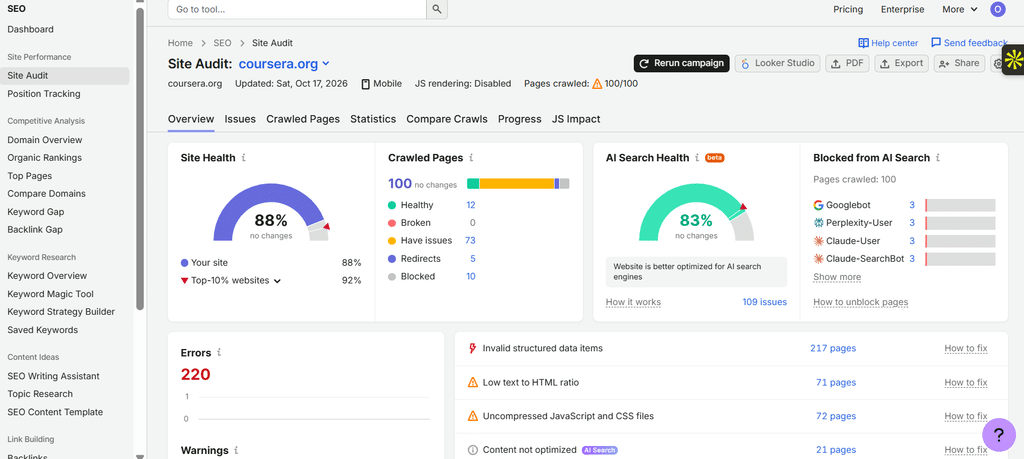
Assign relevant findings to whoever maintains the store.
Give Shoppers Enough Detail to Choose
Start with a product that already receives enquiries or has commercial importance.
For the microphone, collect verified information about:
- Supported devices and connection type.
- What comes in the box.
- The number of speakers it can record.
- Battery specifications and relevant testing conditions.
- Warranty and return arrangements.
- Delivery coverage and availability.
Use the manufacturer’s documentation and the actual product package to check the facts. Explain any compatibility limitations prominently.
Organise the page around the customer’s decision. A short introduction can describe the intended use, followed by specifications, compatibility information and answers to recurring questions.
Our guide to AI search query fan-out explains how related questions can help you build a more complete content brief.
Product images deserve the same care. Show the connectors, included accessories and relevant details clearly. Our article on visual search in Google Search Console covers how to investigate image-led discovery once your pages receive recorded activity.
Where Your Products Appear in AI Search for Retailers
Once you have verified the product information, investigate how your store and relevant products appear in AI-generated answers.
Look for buying questions involving mobile recording, phone compatibility or equipment for two-person interviews. In Semrush’s Visibility Overview, review the available topics and open relevant responses to inspect the descriptions and cited sources.

For example, an answer may reference an older page that leaves out Android compatibility. Follow that citation, check the information and record any correction needed.
Save the platform, response date and cited URL with your findings. Revisit the topic over time to see whether the same description continues to appear.
Our guide to tracking AI brand recommendations explains how to organise those observations.
Follow the Recommendation Through to Checkout
A useful recommendation should lead to a dependable shopping experience.
Open the microphone page on mobile. Select the intended variant, confirm the price and stock status, and check the delivery information. Walk through checkout using an appropriate test process.
Pay attention to controls that are unclear, options that change unexpectedly and charges that appear late in the journey.
Our article on agentic browsing and website readiness explores how clear labels, stable interfaces and understandable forms support website interaction.
Track completed purchases and qualified product enquiries alongside discovery observations. This keeps the commercial outcome visible as you improve the catalogue.
Make Product Information a Shared Responsibility
Use Microsoft’s playbook to organise the product information you already maintain and identify where it needs clarification or correction.
Choose one important item. Verify its details, align the information across connected systems, review its visibility and test the buying journey. Use what you learn to improve the next group of products.
You can try Semrush One free for 7 days as you work through the technical checks and review your store’s AI visibility.

Assign responsibility for each part of the work. If you write product copy, explain suitability and limitations. If you maintain the store, keep product data and checkout behaviour consistent. If you manage marketing, record visibility observations alongside enquiries and purchases.
Repeat the review as prices, stock and product details change. You will give shoppers more dependable information and build a catalogue your team can maintain with confidence.
