
Affiliate disclosure: This article contains affiliate links to Semrush. If you sign up through them, Creaitz may earn a commission at no extra cost to you.
Your agency appears in an AI-generated recommendation. You save the screenshot and send it to your team.
Someone repeats the question. A competitor appears first. By the third attempt, your agency has disappeared.
When you prepare a client report, each screenshot captures one observation. Reviewing the responses together helps you explain recurring appearances and changes.
AI brand recommendations vary between responses. Reporting on them requires a consistent way to collect observations, examine recurring appearances and explain what the findings mean.
Start by choosing questions that reflect how your prospective customers evaluate their options.
Why AI Brand Recommendations Change Between Responses
Research by SparkToro and Gumshoe examined 2,961 responses collected by 600 volunteers across ChatGPT, Claude and Google’s AI experiences. The recommended brands, their order and the number of suggestions varied substantially. Certain brands appeared repeatedly within responses addressing the same underlying need.
A business can therefore appear frequently while occupying different positions in individual answers.
That makes recurring presence useful to examine. The description accompanying a recommendation also matters: an agency may appear regularly with an outdated service list or an inaccurate specialism.
The study covered particular categories, prompts and testing conditions. Its findings support careful sampling and transparent reporting. Your own market will require observation.
Which Questions Deserve a Place in Your Report?
If your email marketing agency serves small online retailers, you could investigate questions such as:
- Which email marketing agencies work with small ecommerce businesses?
- Who can set up abandoned-cart emails for an online store?
- What should a retailer consider when choosing an email marketing agency?
These questions represent different buying situations. Group them under topics such as provider discovery, service requirements and supplier evaluation.
Collect wording from discovery calls, customer enquiries and community conversations. Remove confidential information before entering it into external tools.
For a manageable pilot, choose a small set of questions your team can review consistently. A starting set of 10–20 prompts may suit a limited project; the appropriate coverage depends on your services, audience and resources.
Keep a stable core throughout the reporting period. Record any additions or removals.
Our guide to building a multi-platform search strategy can help you decide which platforms and customer journeys to monitor.
A Clearer Way to Measure AI Brand Recommendations
Track several observations together:
| Measure | What to record |
|---|---|
| Brand appearance | Whether the answer names your business |
| Recommendation context | How the business is presented as an option |
| Website citation | Whether the answer links to your domain |
| Description accuracy | Whether services and other details are correct |
| Supporting sources | The pages cited alongside the answer |
For a manual sample, an observed mention rate can be calculated as:
Responses mentioning your brand ÷ total responses reviewed × 100
Include the sample size, prompts, platform and dates whenever you report that percentage.
Keep platform results separate so readers can see where each observation came from. Check how a tracking provider calculates its own visibility metrics before comparing them with your manual results.
Record brand mentions and website citations in separate fields. Your agency might receive a recommendation supported by a directory listing, while your educational article receives a citation in an answer about email strategy.
Each observation contributes a different piece of evidence.
Give the Monitoring a Routine
Choose a review schedule that fits the decisions you need to make. Keep the question wording, platform and available targeting settings consistent. Save the responses so you can revisit the evidence.
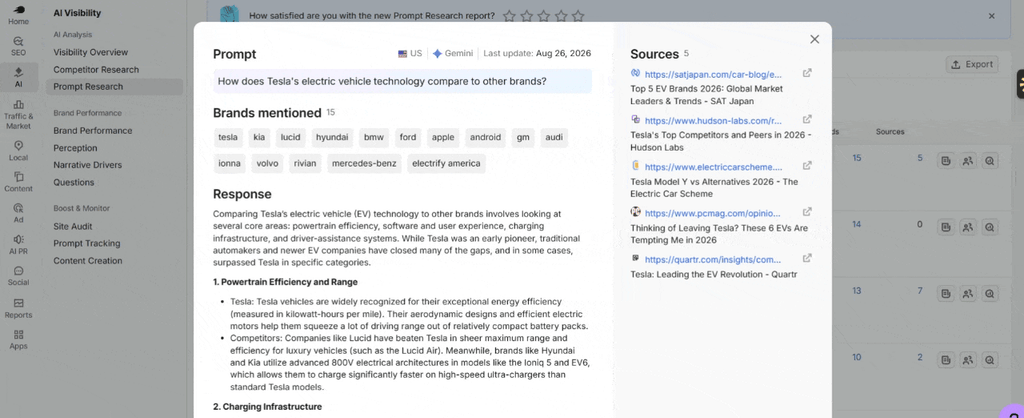
Semrush’s Prompt Tracking helps organise this work through custom prompts, daily monitoring, brand mentions, response snapshots and cited-source reports across supported AI platforms.
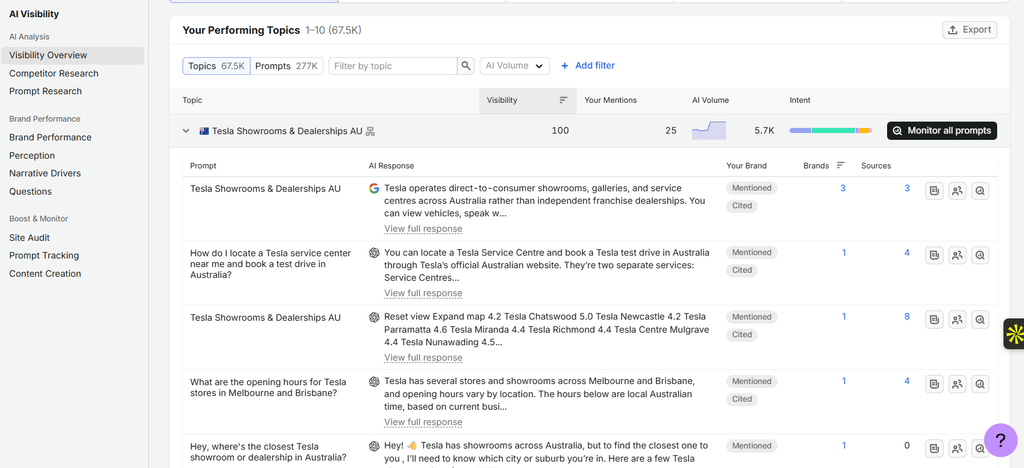
During your review, ask:
- Does your agency appear repeatedly for relevant ecommerce needs?
- Do the answers describe your services accurately?
- Which sources accompany those appearances?
Inspect the saved answers when a pattern changes. A dashboard movement becomes more useful once you understand the response behind it.
You can try Semrush One free for seven days to monitor AI visibility alongside your SEO performance.
Give your next client meeting a little more evidence to work with.
When the Same Error Keeps Appearing
If several monitored answers describe your email marketing agency as a social media management company, investigate the information supporting that description.
Review your service pages, professional profiles and cited directories. Look for vague wording, outdated listings or inconsistent descriptions.
Our article on protecting your brand story in AI-generated search results explains how to investigate cited sources and prioritise factual corrections.
Clarify your ecommerce specialism, correct outdated directory details and explain your current services on the relevant page.
Record the affected URLs and completion dates. Continue monitoring the same questions afterwards. Treat later changes cautiously because AI platforms, retrieved sources and response patterns can also change during the period.
Alongside visibility, maintain a separate record of qualified enquiries and sales. Our zero-click attribution guide explains how to collect customer-discovery evidence and record what remains uncertain.
Build a Record You Can Explain
Changing recommendations make consistency in your own process essential.
Start with customer questions that matter to the business. Collect observations under documented conditions, review recurring mentions and inspect the accuracy of the answers. Use those findings to prioritise specific improvements to your website and public information.
In your reports, show the monitoring scope, evidence collected and actions taken. Keep the sample size, platforms and observation dates visible.
Over time, you can use that record to identify persistent gaps, prioritise factual corrections and explain how your brand appears across relevant customer questions.
