

Affiliate disclosure: This article contains affiliate links to Semrush. If you sign up through them, Creaitz may earn a commission at no extra cost to you.
Making a page easier for AI systems to summarise sounds like an obvious improvement. Add a concise comparison, highlight your strengths and make important information easier to extract.
But how do you know whether the change helps your website overall—not just its appearance in AI answers?
That is the practical GEO vs SEO question.
Generative engine optimization (GEO) aims to improve visibility in AI-generated answers, while SEO supports discovery through traditional search.
The same page can serve both, but an improvement in one does not automatically establish success in the other.
For a freelancer or marketing team, the goal is not simply to earn another mention but to attract the right people without weakening what already brings in business.
More AI Traffic Doesn’t Always Mean a Better Result
Travel-booking platform Omio tested this challenge with SearchPilot by measuring how specific page changes affected both LLM-referred visits and Google organic sessions.
One experiment added a section explaining the brand’s unique selling points. LLM-referred sessions increased by 18%, while the Google organic result was inconclusive: the test did not establish a clear benefit or harm in that channel.
A separate experiment added quantitative and comparative bullet points above an existing summary table. LLM traffic improved, but the test indicated a likely 6.5% decline in Google organic sessions. Because Google organic was Omio’s largest traffic source, the team decided against rolling out that version.
This does not mean bullet points hurt SEO or that brand-benefit sections always increase AI referrals. These were particular changes tested on one business’s pages.
The lesson is about the decision process: measure the channels a change could affect before declaring it a success.
You may not manage a travel platform with thousands of pages. But you can apply that discipline to a service page, course landing page or resource hub—starting with one clearly defined change.
How to Test GEO Changes Without Losing Sight of SEO
1. Test one change at a time
Imagine you are a freelance web designer. Prospective clients regularly ask whether they need a landing page or a full website.
You could add a concise comparison to your service page, explaining the differences in scope, deliverables and suitable use cases. That would address a real customer question while giving AI systems clearer information to reference.
Your hypothesis might be:
Adding a service-comparison section will help visitors choose the right option and may improve relevant AI visibility, without reducing qualified organic enquiries.
Now you have something specific to evaluate.
Add the comparison, but avoid changing the page title, pricing, internal links and enquiry form at the same time. Otherwise, any movement becomes harder to interpret.
Save the original version and record the affected URL, publication date and exact edit. Then decide what you will monitor—and what deterioration would make you reconsider the change.
That turns “make it AI-friendly” from a vague instruction into a manageable experiment.
2. Decide what must not get worse
Before editing, identify the page’s business purpose.
For the web designer’s service page, the main outcome is qualified enquiries.
Before publishing the comparison section, decide what you will monitor:
- Business Outcome: Enquiries that match the services you offer.
- SEO Guardrails: Google clicks to the page and rankings for relevant service keywords.
- AI Indicators: Appearances in relevant answers, citations and identifiable referral visits.
Use a consistent definition of a qualified enquiry before and after the change.
There is no universal acceptable percentage decline. You should set expectations using your traffic volume, normal fluctuations and business priorities.
An AI citation and a qualified enquiry are different units. Adding them together does not produce a meaningful “net win.”
3. Monitor the same pages and conditions
Keep the comparison focused on the edited service page.
Track relevant searches, such as “landing page designer,” alongside AI questions about choosing between a landing page and a full website.
These are illustrative tracking ideas though, not claims about searches your audience has made.
Use Semrush’s Position Tracking to monitor relevant Google keywords with a consistent location, device and keyword set.

Daily ranking observations can help flag movement around the experiment, but rankings are not sessions, revenue or proof of causation.
Alongside that, review relevant prompts, mentions and cited pages in Visibility Overview.

Keep the platform, market and reporting period consistent where those controls are available. Record the report’s scope rather than treating it as a complete record of every AI answer.
Use your own Search Console and analytics data for observed search clicks, sessions and business actions.
Semrush One brings SEO and AI visibility tools into one subscription. It does not automatically turn a before-and-after comparison into a controlled experiment.

4. Match the method to your website’s size
Omio’s testing approach used statistically similar groups drawn from thousands of comparable pages.
A small portfolio or community website may not have that scale.
You can still make a limited, reversible change and observe it carefully.
If you have genuinely comparable service pages, leave some unchanged as a reference.
A contact page or unrelated blog post is not a reliable control for your edited service page.
Even comparable pages may attract different audiences, so a simple before-and-after review remains directional rather than causal proof.
However, do not describe a handful of dissimilar pages as a statistically reliable A/B test.
Record other developments: campaigns, technical changes, seasonal demand and search updates.
Low traffic may leave the result inconclusive. That is a valid outcome too.
5. Choose: keep, revise, reverse or wait
At the review point, consider the evidence together.
- Keep: the change helps users and business outcomes, with no material deterioration observed in the guardrails.
- Revise: one channel improves while another shows a concerning decline.
- Reverse: there is credible evidence of material harm and a practical rollback is available.
- Wait: the observation period or data volume is insufficient.
For the web designer, more AI mentions with fewer qualified enquiries would be a reason to investigate. Clearer enquiries and stable search performance would be encouraging, but still would not prove that the comparison section caused the improvement.
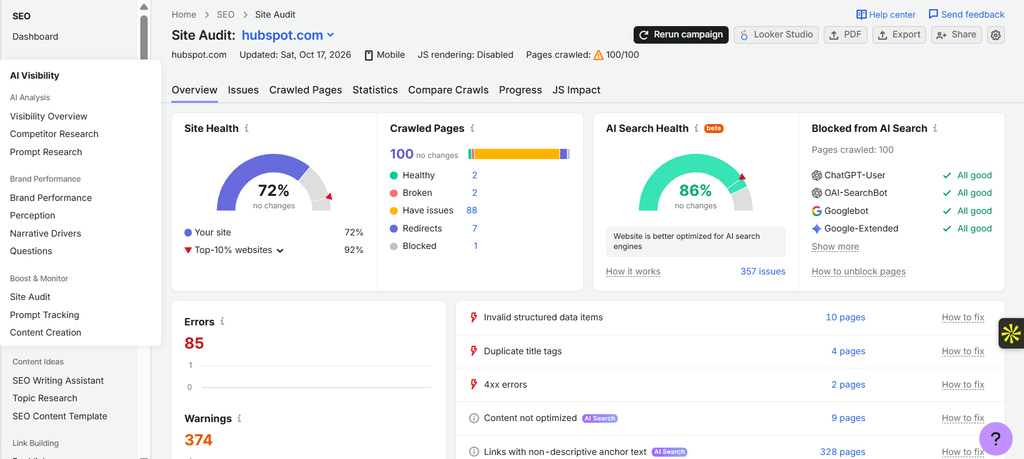
If performance falls, inspect technical issues too. Site Audit can surface broken links, crawlability problems and other implementation issues that deserve investigation. It cannot determine by itself that a GEO change caused the decline.
The aim is not to protect SEO from every experiment. It is to protect the business from confident conclusions drawn from incomplete evidence.
Before giving your next AI-friendly rewrite the keys to every page, let it pass a driving test.
Try Semrush One free for seven days to establish SEO and AI-visibility baselines. Features and limits vary by plan; the tools support monitoring, not guaranteed results or automatic causal proof.
