
A useful content plan has to make choices.
With five hours available this week, should you improve a service comparison, expand a tutorial, update your pricing explanation or publish another article?
Generative engine optimization adds another consideration: whether your information helps answer the questions people bring to AI search tools.
That creates a prioritisation problem for marketers, freelance writers and small business owners. A GEO content strategy needs a clear way to connect customer questions, existing pages and the evidence required to improve them.
Here is a manageable starting point: choose one important customer decision and build the information needed to support it.
Affiliate disclosure: This article contains affiliate links to Semrush. If you sign up through them, we may earn a commission at no extra cost to you.
Start Where the Customer Has to Choose
Look through enquiries, support messages, consultation notes and community discussions.
Pay attention to questions people ask before committing time or money:
- Which option suits my situation?
- What will it cost?
- What does the service include?
- What happens if my requirements change?
- What should I prepare before starting?
For a hypothetical freelance email marketer, a recurring enquiry might concern choosing between a one-off newsletter setup and ongoing campaign management.
A prospective client needs to understand the deliverables, responsibilities, fees and circumstances suited to each service.
That gives the freelancer a specific page to assess.
Our guide to building a content strategy explains how audience needs and business objectives can shape those publishing decisions.
Match Your GEO Content Strategy to the Question
Choose a format that lets you explain the decision properly.
| Customer question | Useful starting format | Details to include |
|---|---|---|
| Which service should I choose? | A balanced comparison | Scope, suitability, limitations and responsibilities |
| How much should I budget? | A pricing explanation | Assumptions, inclusions and factors affecting the estimate |
| How do I complete this task? | A tutorial | Requirements, steps, screenshots and troubleshooting |
| Will this work in my situation? | An example or case study | Conditions, evidence, constraints and relevant outcomes |
Siege Media’s study of 116 B2B website properties found that versus-page counts had the strongest correlation with AI-referred sessions among the comparison formats it examined.
The research provides a reason to investigate relevant comparison content. Its findings describe a particular sample and observation period; other factors, including brand strength and category, also affect performance.
For the email marketer, a service comparison deserves attention because clients already need that explanation.
Use the research to inform your priorities and validate them against your own audience.
Inspect the Answers Already Available
Before rewriting, examine a few relevant AI responses.
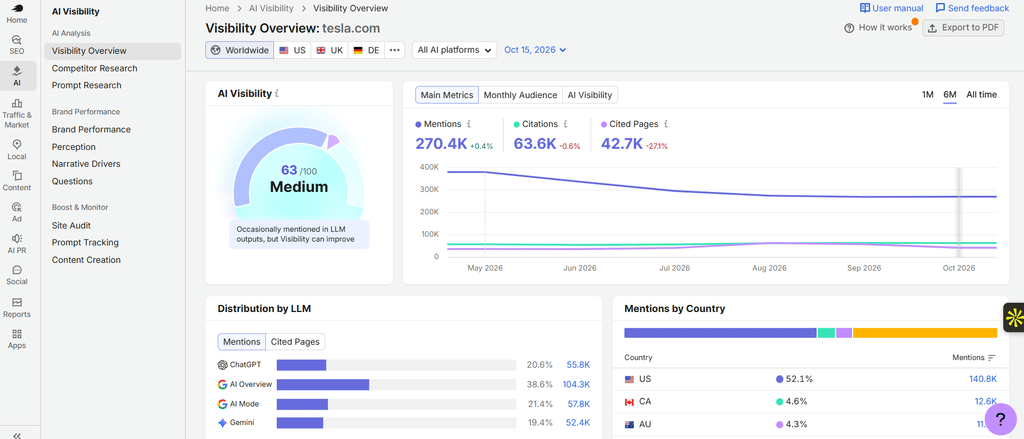
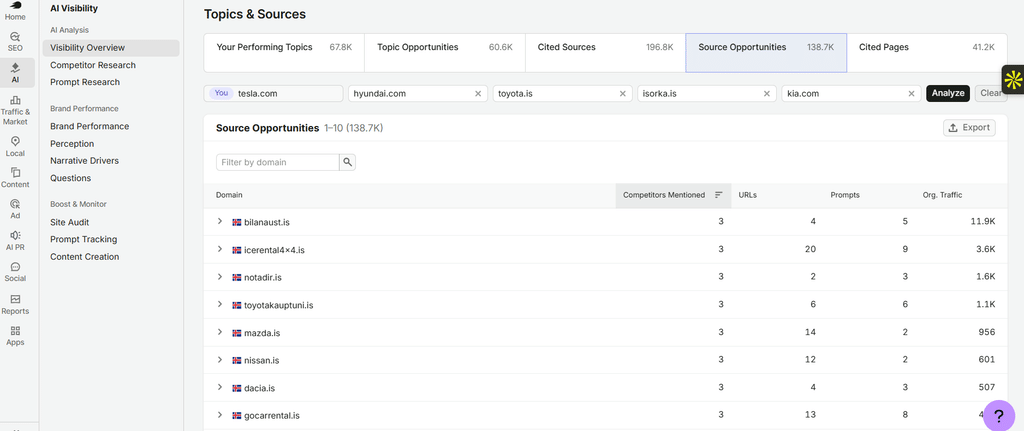
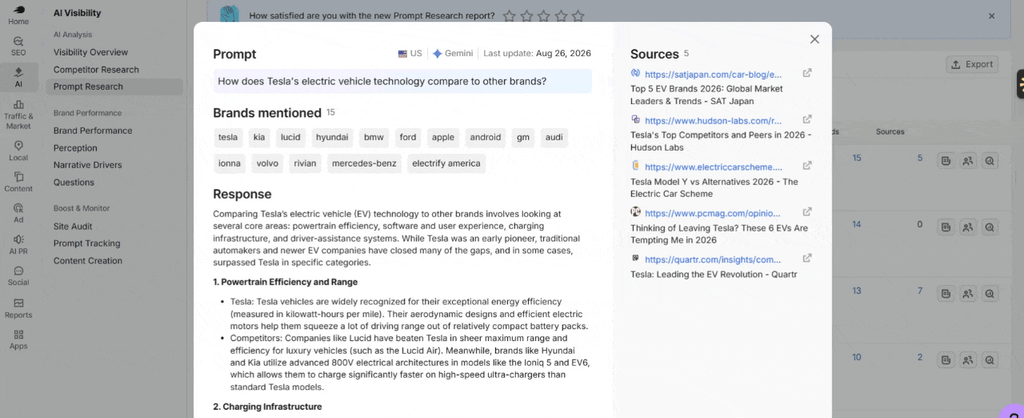
In Semrush’s Visibility Overview, you can review available responses and their cited URLs.
Open the sources and inspect the information they provide.
Look for specific details:
- Does the cited page explain who each option suits?
- Are costs accompanied by assumptions?
- Can the reader identify the author or business?
- Are limitations explained?
- Is the information current?
Record useful observations alongside the page you intend to improve.
A competitor’s citation gives you a source to investigate. Several observations across relevant questions can help you decide where further research is worthwhile.
Keep the scope manageable. Begin with the platforms your customers mention or that appear in your referral and discovery records.
Give the Answer Enough Context to Travel
A section should remain understandable when someone encounters it through a search result, shared link or quoted excerpt.
For the freelancer’s comparison page, “This option is cheaper” leaves too much unresolved.
A clearer explanation would identify the service and its scope:
A one-off newsletter setup can suit a business with someone available to write and send future campaigns. The agreed setup fee should specify whether it includes template design, account configuration, contact migration and training.
Name the subject, explain the conditions and support consequential claims. Use headings that help readers navigate the decision.
Google’s guidance for generative AI search recommends useful, well-organised content and explicitly says there is no requirement to divide pages into tiny chunks.
Let the explanation determine the section length.
Keep One Reliable Home for the Details
Decide which page holds the current service information.
A LinkedIn post, video or community answer can explain one part of the decision and direct interested readers to that page. Adapt the presentation to the platform and keep important facts consistent.
For example, a short video could explain who handles campaign writing under each service. The website can carry the fuller scope and pricing assumptions.
Our article on digital PR for AI visibility explores how useful contributions and accurate third-party information support a wider public presence.
Choose distribution channels you can maintain. Each additional version creates another place to update when the offer changes.
Review Your GEO Content Strategy After the Update
Save the original page and record the changes.
Monitor relevant Google keywords in Semrush’s Position Tracking. For selected AI questions, Prompt Tracking supports monitoring across ChatGPT Search, Google AI Mode and Gemini.
Keep the question set and targeting consistent, and review repeated observations over time.
Alongside visibility, record enquiries, referral visits and whether clients arrive with a clearer understanding of the service.
Our guide to GEO vs SEO testing covers the limitations of before-and-after comparisons and the importance of documenting other changes.
You can try Semrush One free for seven days to establish those search and AI-visibility observations. Give the next update a reason to earn its place on the calendar.
Leave the Reader Better Equipped to Decide
A sustainable GEO content strategy starts with a question worth answering and a page you can improve responsibly.
Choose a meaningful customer decision. Explain the options with accurate details, make the supporting information accessible and maintain consistency wherever you share it.
Then review what people and monitored search experiences do with the result.
For a small team, that creates a workable cycle: select, research, improve, distribute and learn. Each round should leave behind a more useful page and a clearer reason for the next investment.
