
How many versions of your business exist online?
Your homepage may describe a training company. Your LinkedIn page still advertises consulting. An old directory lists a previous name, while the course pages barely mention the organisation delivering the training.
Each description may have made sense when someone wrote it. Together, they leave basic questions unresolved.
Entity-based SEO involves helping search systems understand identifiable things—such as a business, person or product—and the relationships between them.
For freelancers and small teams, the work can begin with a simple editorial task: making the business’s identity, services and ownership easy to establish across its public information.
Affiliate disclosure: This article contains affiliate links to Semrush. If you sign up through them, we may earn a commission at no extra cost to you.
Give Your Business a Consistent Introduction
Write a short factual description that answers:
- What is the business called?
- What does it provide?
- Who does it serve?
- Where does it operate?
- Which website and profiles officially represent it?
A hypothetical training business might describe itself as a Lagos-based provider of live digital-marketing courses for early-career professionals.
That description gives an editor, developer or prospective student something concrete to work with.
Check the homepage, About page, contact details, service pages and official profiles against those facts. Explain relationships clearly when the founder, business and individual courses have different names.
Different platforms can use different wording. The underlying facts should agree.
Keep this information in a shared record and assign someone to maintain it when services, locations or ownership change.
The Connections That Support Entity-Based SEO
A website can make business relationships explicit through its navigation, page content and structured data.
For the training provider, course pages should identify the organisation delivering the course. Tutor biographies should explain each person’s relevant role. Contact and About pages should be accessible through ordinary links.
Structured data adds a machine-readable description of appropriate details.
Google’s Organization documentation explains that organisation markup can help it understand administrative information and distinguish one organisation from another.
Relevant properties may include:
- name and a genuine alternateName.
- The official website url.
- A representative logo.
- Applicable business contact details.
- sameAs links to profiles representing the same organisation.
Choose the type that accurately describes the subject. A freelance professional and a registered training company may need different implementations.
Include truthful, relevant information and check the markup against the published business details. Avoid adding unrelated publications to sameAs simply because they mention the company.
For a WordPress site, ask the developer to inspect what the existing theme and SEO plugin already generate. Several components may be supplying conflicting descriptions.
Correct implementation supports clarity. Google also states that structured-data features remain subject to its eligibility requirements and are never guaranteed.
Check What the Page Actually Delivers
Clear business information needs to be accessible on the page.
Ask your developer to compare the initial HTML response with the rendered page. Review whether important details—business name, service description, course dates and pricing—appear only after JavaScript execution or a user interaction.
Google’s JavaScript guidance describes its rendering process and recommends considering server-side rendering or pre-rendering because some bots cannot execute JavaScript.
The right implementation depends on the site and the systems you want to support.
Semrush’s Site Audit provides technical checks and configurable JavaScript rendering. Review findings associated with important pages and investigate differences in what the configured crawl can retrieve.
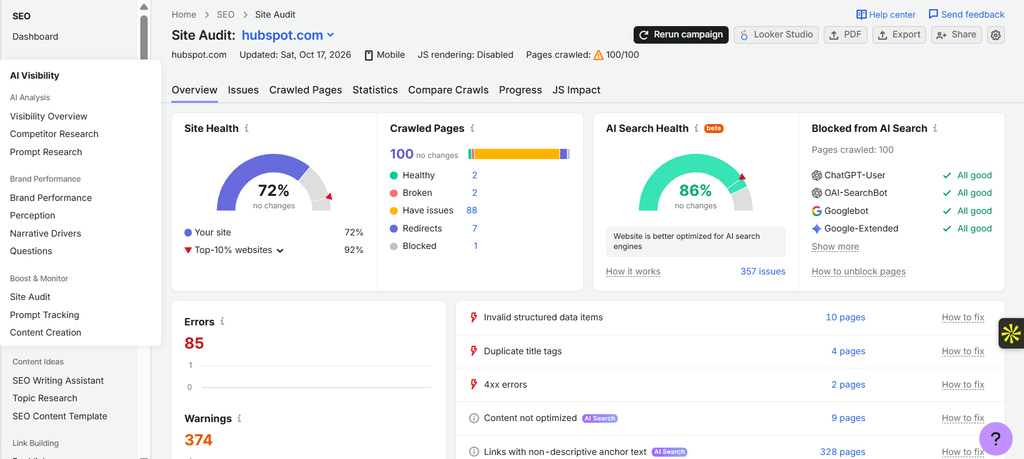
Keep each observation specific: which URL, which content, which crawl configuration and what was missing.
Our guide to AI crawler access covers the separate checks for firewall restrictions and bot-specific access.
Review How Outside Sources Describe You
Once your own information is clear, inspect the public descriptions beyond your website.
Look for outdated names, incorrect locations, discontinued services and confusion between the business and its founder.
Request factual corrections from directories you can verify. Update profiles you control. Keep a record of requests that require another publisher’s involvement.
Our recent article on digital PR for AI visibility explains how to investigate third-party information and contribute useful expertise to wider conversations.
You can also examine relevant AI answers. In Semrush’s Visibility Overview, review available responses and cited URLs to see how your business is described in those observations.
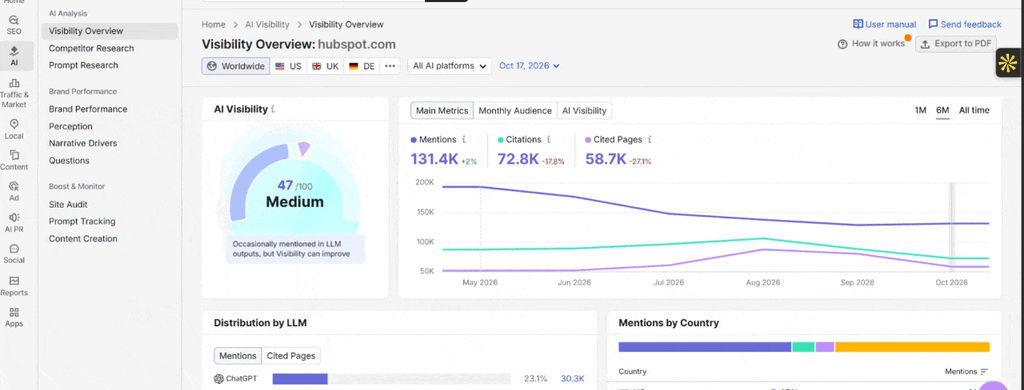
Record the platform, question, date and exact factual issue.
An incorrect description gives you a research lead. Follow the cited pages and check their information before choosing a correction.
Keep Identity, Access and Interaction on the Maintenance List
These checks involve different responsibilities.
An editor can maintain the business description. A developer can investigate rendering and markup. A marketing lead can review profiles and monitored AI responses.
Assign owners so an update to one part of the business reaches the other places that describe it.
Our guide to agentic browsing and website readiness explores the additional question of whether an agent can navigate and interact with a website.
You can try Semrush One free for seven days to investigate technical findings and available AI descriptions. Your business already has an introduction; it is worth checking which version is circulating.

Leave a Clearer Record of the Business
Entity-based SEO gives small teams a useful maintenance discipline: document the business accurately and make its relationships understandable.
Start with the details a prospective customer needs. Align the pages and profiles you control, check the structured data, and investigate whether important information is accessible.
Then revisit those details whenever the business changes.
A clear public identity helps people evaluate your work and gives search systems more coherent information to interpret.
